

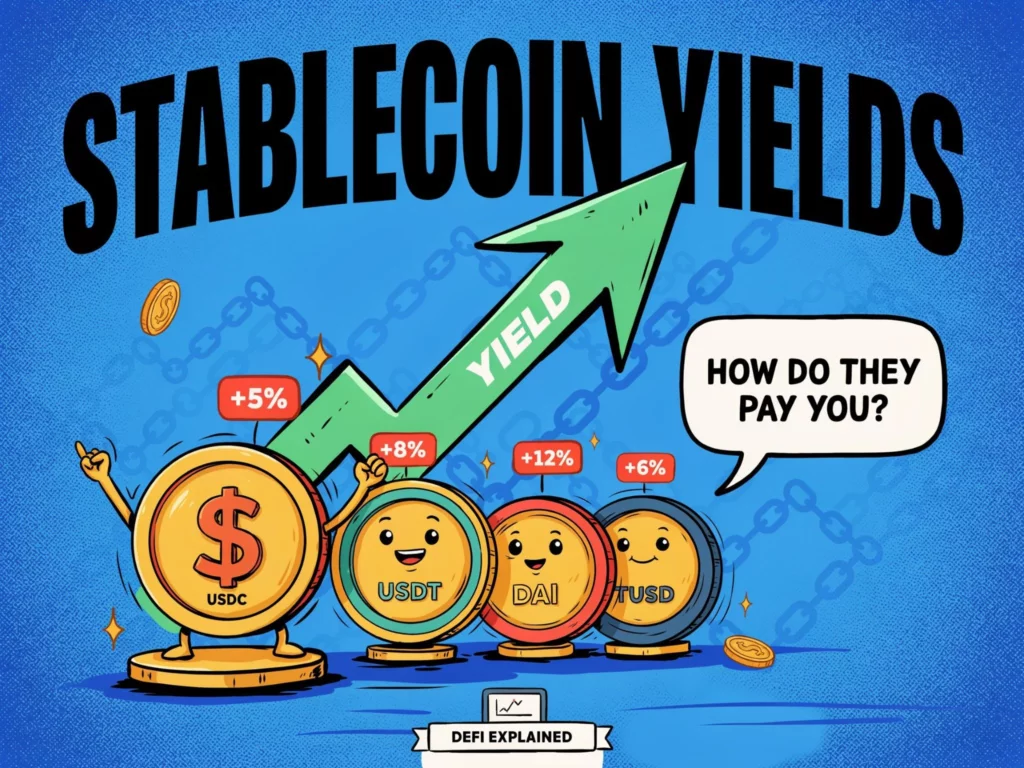
Every stablecoin yield product answers the same awkward question.Your USDC doesn’t appreciate. It’s engineered not to. So when a platform offers you 4%, 8%, or 20% on a dollar-pegged token, that money is coming from somewhere specific — and the “somewhere” is the only thing that matters.
Most comparison posts rank these by headline APY. That’s exactly backwards. A 12% yield funded by a sustainable market mechanism is a completely different product from a 12% yield funded by token emissions that run out in six months.
So this ranking does it the other way round. Six ways to earn yield on stablecoins, ordered by how durable the underlying source actually is.
The one thing to check before you deposit anywhere
Ask what the counterparty is doing with your money to generate the return. There are only a handful of honest answers:
- They’re lending it to someone who pays interest
- They’re putting it in Treasuries and sharing the coupon
- They’re running a trading strategy that generates returns
- They’re paying you out of token emissions or marketing budget
The first three are businesses. The fourth is a countdown. If a platform can’t tell you which one it is in a sentence, that’s your answer.
1. Funding-rate arbitrage — yield from a market mechanism
The source: perpetual futures contracts pay funding between long and short holders every few hours to keep the contract price tethered to spot. Crypto traders lean long most of the time, so shorts tend to collect. BitMEX’s Q3 2025 analysis found funding was positive for over 92% of the quarter — a persistent tilt, not a one-off.
A position that holds spot and shorts the perpetual collects that funding while the two legs cancel out directionally. The return isn’t coming from a token printer or a borrower who might default. It’s coming from leveraged traders paying to keep their positions open.
Typical return: varies with funding conditions and strategy. VectorTraders publishes target ranges from 7.8% to 43.3% annualised across its plans, depending on term and strategy mix.
The catch: funding can stay negative for extended periods, which inverts the payment direction. Execution runs on third-party exchanges, so venue risk is real. And running it yourself means managing two legs across venues continuously — which is why most people access it through a managed product rather than doing it directly. The full mechanism is explained here, worked example included.
Why it ranks first: the source is structural rather than promotional. Perpetual futures aren’t going anywhere — on-chain perp DEXs alone turned over $593 billion in 30 days as of September 2026 — and as long as traders use leverage, someone is paying funding.
Start small and see how it behaves. VectorTraders’ entry plan opens at $100 on a seven-day term, which is about the cheapest way to watch funding capture work in practice. See the current plans →
2. Tokenized Treasuries — yield from government debt
The source: your stablecoins buy short-dated US Treasury bills through a tokenized fund, and you receive the coupon.
Typical return: tracks short-term Treasury rates, minus a management fee. Whatever T-bills are paying, roughly.
The catch: returns are capped at the risk-free rate, and they fall when rates fall. Many of these products are also restricted to accredited or institutional investors, and redemption can take a business day or more.
Why it ranks second: it’s the most boring source on this list, and that’s the compliment. You know exactly where the money comes from.
3. DeFi lending — yield from borrowers
The source: protocols like Aave and Morpho let you supply stablecoins to a pool that borrowers draw from, paying interest. Rates float with utilisation.
Typical return: low single digits in quiet markets, spiking when leverage demand runs hot. Highly variable.
The catch: smart contract risk is the obvious one. The subtler one is that rates collapse exactly when you most want them — in calm markets, nobody’s borrowing. You’re also exposed to the protocol’s liquidation machinery working correctly during a crash, which is the moment it’s under the most stress.
4. Exchange rewards programmes — yield from a revenue share
The source: exchanges pay rewards on stablecoin balances, typically funded by sharing the interest the issuer earns on its reserves.
Typical return: low single digits. Coinbase’s USDC rewards have run around 3.5%.
The catch: this is the category regulators have been circling. The GENIUS Act, signed in July 2025, bars stablecoin issuers from paying yield on reserves directly. The CLARITY Act would have extended restrictions to platforms, but it failed a Senate procedural vote 49–50 in September 2026, so the platform-level ban never became law. A proposed OCC rule on affiliate arrangements remains unresolved.
Translation: this yield source exists at the pleasure of a rulemaking process that is still moving. Fine for parking cash. Not something to build around.
5. Yield-bearing stablecoins — yield baked into the token
The source: the token itself accrues value, usually from Treasuries or a delta-neutral strategy run by the issuer.
Typical return: varies enormously by product, because “yield-bearing stablecoin” describes a mechanism, not a risk level.
The catch: you’re taking the issuer’s strategy risk and their peg risk simultaneously, and the two are correlated — if the strategy breaks, the peg is what breaks. Read what’s actually backing it. Some are Treasury wrappers. Others are leveraged positions with a dollar sign on the front.
6. Liquidity provision and yield farming — yield from emissions
The source: you supply stablecoins to a liquidity pool and earn trading fees plus, usually, token rewards.
Typical return: the advertised numbers are the highest on this list, and the realised numbers frequently are not.
The catch: headline APYs on stablecoin farms are typically dominated by token emissions rather than fees. Emissions decay, the token price usually falls as rewards are sold, and the quoted APY assumes neither happens. Add impermanent loss on non-pegged pairs and smart contract risk on top.
Why it ranks last: not because it never works — it sometimes works very well — but because the source is a marketing budget with a timer on it.
Side by side
| Method | Where the yield comes from | Durability | Main risk |
| Funding-rate arbitrage | Leveraged traders paying funding | Structural | Negative funding periods, venue risk |
| Tokenized Treasuries | Government debt coupons | Very high | Rate-dependent, access restrictions |
| DeFi lending | Borrower interest | Moderate | Smart contract, rate collapse |
| Exchange rewards | Issuer reserve revenue share | Uncertain | Regulatory |
| Yield-bearing stablecoins | Varies by issuer | Varies | Strategy and peg risk combined |
| Liquidity provision | Trading fees + token emissions | Low | Emission decay, impermanent loss |
How to actually choose
If you want the yield to still be there in two years, weight durability over headline rate. Tokenized Treasuries and funding-rate strategies both have sources that exist independently of anyone’s marketing budget.
If you’re parking cash for a few weeks, exchange rewards are frictionless and the regulatory question won’t resolve in your holding period. Just don’t plan around it.
If you want the highest sustainable rate, funding-rate arbitrage has historically offered more than Treasuries because it’s compensating you for real operational work — running two legs across venues, managing exchange exposure, handling the periods when funding inverts. That’s a genuine return source, not a free lunch, and it comes with genuine risk.
If you’re drawn to a 20%+ farm APY, work out what percentage is fees and what percentage is token emissions before you deposit. The answer is usually uncomfortable.
One rule covers all of it: if you can’t explain where the money comes from, you’re not earning yield. You’re providing it.
Want the funding-rate route without running it yourself? Plans start at $100 with a seven-day term. Explore VectorTraders →
FAQ
What is the best stablecoin yield in 2026?
It depends on what you’re optimising for. Tokenized Treasuries offer the most predictable source. Funding-rate arbitrage strategies have historically offered higher rates in exchange for operational and market risk. Headline APYs on farms are usually the highest and the least durable.
Is stablecoin yield legal in the US?
The GENIUS Act bars stablecoin issuers from paying yield on reserves directly. The CLARITY Act would have extended restrictions to platforms but failed a Senate procedural vote in September 2026. Rules in this area are still developing, so check current terms with any provider.
Why do stablecoins pay yield at all if they don’t appreciate?
They don’t, on their own. The yield comes from whatever the platform does with the deposit — lending it, buying Treasuries, or running a trading strategy. The token is just the unit you deposit and withdraw in.
What’s the safest way to earn on stablecoins?
No option here is risk-free. Tokenized Treasuries carry the least strategy risk because the underlying is government debt. Every other method adds counterparty, smart contract, or market risk on top.
How much can you earn on USDT or USDC?
Low single digits from exchange rewards and Treasury products. Variable from DeFi lending. Higher from strategy-based products — VectorTraders publishes target ranges from 7.8% to 43.3% annualised depending on plan and term, with returns varying by market conditions.
Can funding rates go negative?
Yes. When markets lean short, longs get paid instead. BitMEX found funding positive for over 92% of Q3 2025, but negative stretches have persisted for weeks in past drawdowns — most notably in March 2020 and after the FTX collapse in November 2022.
Disclosure: This content is provided by a third party. Neither crypto.news nor the author of this article endorses any product mentioned on this page. Users should conduct their own research before taking any action related to the company.




Leave feedback about this