

Record mining costs are changing the industry as firms exit Bitcoin production and pursue AI-driven business opportunities.
Bitcoin miners are facing a difficult period as rising expenses and weaker revenues pressure operations across the industry. CoinShares’ latest quarterly mining review shows that listed miners fell below cash breakeven levels in aggregate during Q2 2026. Several companies are now reducing Bitcoin production or shifting toward AI and high-performance computing services.
Bitcoin Mining Costs Hit Record Pressure as Margins Shrink
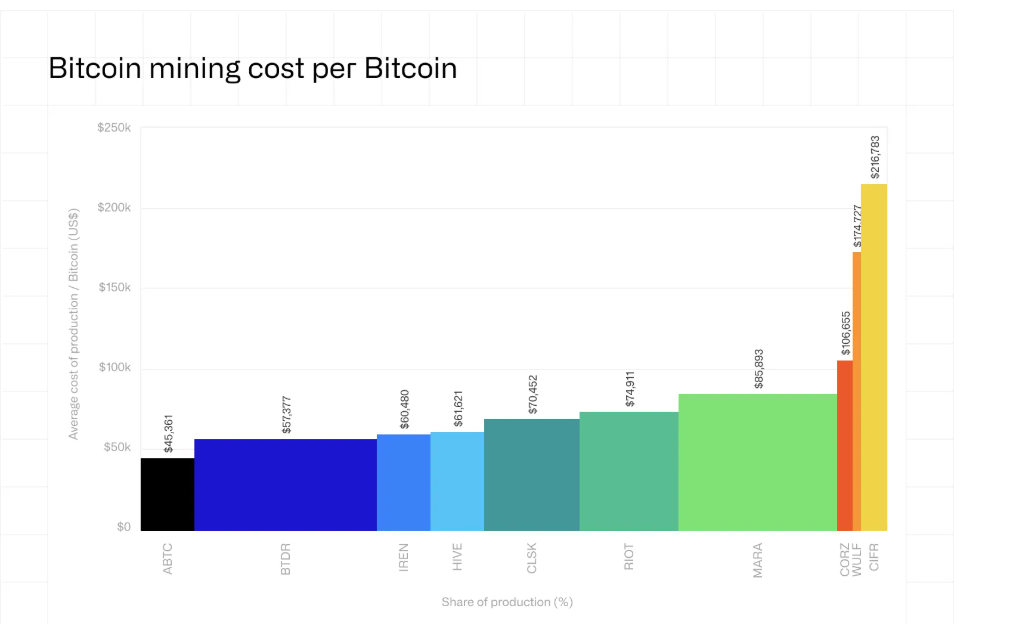
CoinShares’ quarterly review found that the weighted average ex-tax cash cost to produce one Bitcoin among listed miners reached about $75,500 in Q2 2026. Bitcoin ended the quarter at $58,400, creating pressure for operators with higher expenses. The monthly average hash price dropped to a record low of $27.7 per PH/s per day in June.
Source: CoinShares
Several miners have responded to the pressure by cutting capacity and shifting resources toward new business areas. Core Scientific incurred a $41.9 million loss after canceling its remaining orders for next-generation mining hardware, removing approximately 15 EH/s of planned mining capacity.
Meanwhile, Keel halted Bitcoin mining operations on June 29 and is expected to record zero mining revenue in Q3. In addition, IREN and Cipher moved closer to exiting mining activities, with more than 35 EH/s scheduled to leave from the listed mining group.
According to CoinShares, companies are increasingly moving toward AI data centres and hosted computing services. IREN reported that AI cloud revenue surpassed mining revenue for the first time. TeraWulf also increased its focus on high-performance computing leases, which now account for most of its revenue.
Mining conditions weakened due to lower Bitcoin prices, rising power expenses, and reduced profitability for older machines. The network’s hash rate declined sharply during the first half of 2026, with companies removing unprofitable equipment from service. CoinShares said the decline reflected economic pressure rather than a permanent break in the mining cycle.
Energy Assets Become Key Advantage in Bitcoin Mining Transition
Despite the pressure, the report noted that Bitcoin mining is not disappearing. Instead, many public miners are changing their business models. Some are keeping mining operations while adding AI services, while others are leaving mining entirely.
Existing energy infrastructure has gained attention as companies search for new opportunities. CoinShares noted that restrictions on new data center construction have increased demand for sites with existing power access. Some mining facilities are being considered for AI and computing workloads instead of traditional Bitcoin production.
Future mining activity will depend on Bitcoin prices, electricity costs, and hardware efficiency. Meanwhile, CoinShares expects some miners to remain focused on Bitcoin, while others continue shifting toward AI and high-performance computing projects.
As margins tighten, the mining industry is entering a period of major change. Companies are adjusting their strategies as profit margins shrink and energy assets gain new value. Going forward, the sector is likely to combine Bitcoin mining and computing services rather than mining alone.





Leave feedback about this