

Disclosure: This article does not represent investment advice. The content and materials featured on this page are for educational purposes only.
Poly Truth and Meme Punch presales gain traction in 2026 crypto market narrative around utility tokens.
Summary
- Crypto presales sell tokens before exchange listing in phased stages, often with rising prices and fixed supply caps.
- Poly Truth (PTRUE) analyzes prediction markets using AI layers, offering research-based outputs without executing trades.
- Meme Punch (MEPU) is a play-to-earn game where token demand is driven by PvP gameplay and in-game utility.
The phase where a project sells its token prior to listing on any exchange is known as a crypto presale. The project sets the price, the supply is fixed, and buyers receive their tokens when the presale ends and the claim window opens.
Most presales have funding caps and operate in phases. Early entries are typically less expensive than later ones because when a stage fills, the next one opens at a higher price. Clear token utility, published tokenomics, and audited contracts are indicators of the best crypto presales. Below are two May 2026 presales that meet that criteria.
Best crypto presales for May 2026
1. Poly Truth (PTRUE)
Winning on a prediction market comes down to how well someone has done their research, and Poly Truth is built to handle that part. Anyone betting on the outcome of an election, a central bank decision, or a sports event is working against a deadline, and most of the relevant information is scattered across news sites, social platforms, and historical data. Reading through all of it before the betting window closes is not realistic. The tool does that work and gives a breakdown of which outcomes the data points toward.
The setup runs on a three-character framework. The Runners are the data scrapers, gathering data from the web the moment a prediction event is submitted. The Starlet handles the analysis layer, cross-referencing sources and assigning probability scores. The Presenter outputs the final brief in a structured format. No bets are placed, no automated trades are run. The output is research and nothing more.
Token details:
- Built on Ethereum with a total supply of 11.5 billion
- Presale takes 40% of supply, with liquidity at 17%
- Team allocation under a 3-month cliff and 12-month vest
- Holders get tiered access to the research tool once it goes live
- Audited by SolidProof and Coinsult, with both reports public
2. Meme Punch (MEPU)
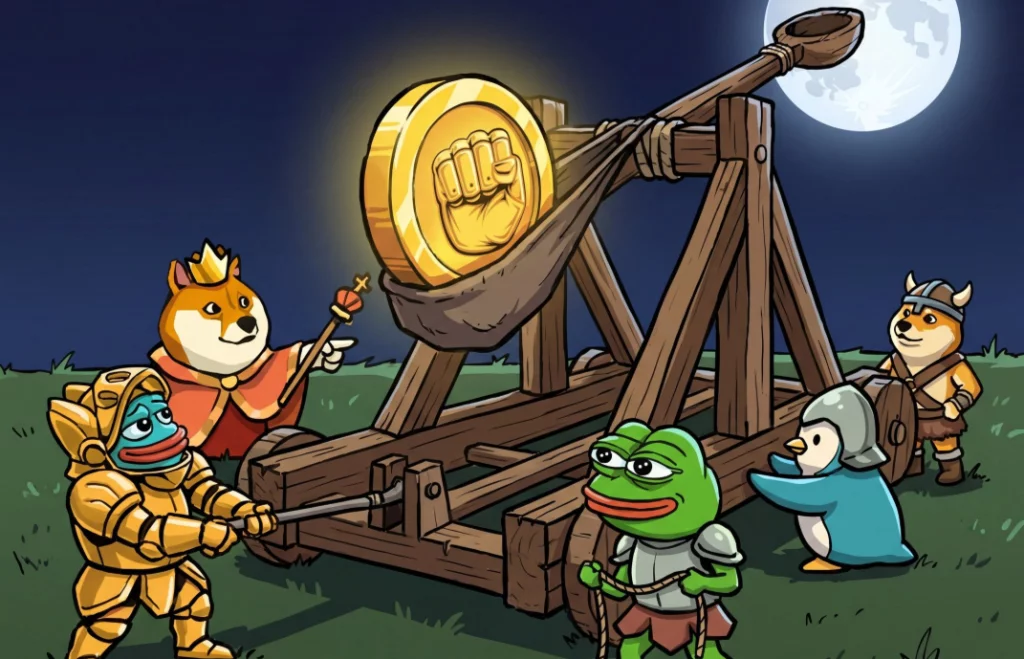
Meme Punch is a play-to-earn game where the token is the in-game currency, not just a coin to hold. Players pick a knight, fight other players in a medieval arena, and earn MEPU by winning matches and climbing the leaderboard. The five playable characters are from meme-coin culture.
Each member of the lineup — Pepe, Doge, Floki, Brett, and Pudgy Penguin — is dressed in armor. Combat is PvP; wins will move players up in the ranking system and give them access to MEPU prizes. Because the token can be used to purchase weapons, character skins, and special abilities within the game, demand is directly linked to player engagement.
Token details:
- Built on Ethereum with a total supply of 10 billion
- Presale takes 40% of supply, with staking at 14.5% and liquidity at 12%
- Game rewards allocated 9.5% of supply
- Payment options include ETH, BNB, SOL, USDT, USDC, and card
- Current presale price and staking APY are listed on the official website
How presale stages and pricing work
Most presales are divided into stages rather than charging a single flat fee. Every stage has a fixed price and a set number of tokens available for purchase at that price. The next stage opens at a higher price after the previous one sells out. Also, some presales automatically increase the price within a stage every few days. One of those is Poly Truth, whose price changes every four days.
The majority of presales have standard payment options. Nearly all places accept ETH, BNB, SOL, USDT, and USDC. Larger projects also accept card payments and bank transfers, such as SEPA.
Tokens are not provided at the time of purchase. When the presale ends, which is typically around the time the token lists on an exchange, the project holds them and releases them. This is referred to as the claim. One thing to keep in mind is that even if a buyer paid with SOL or BNB, they will still need to provide an Ethereum wallet address at the time of the claim if the presale runs on Ethereum.
What to know before the claim opens
Here are some helpful pointers for anyone considering a presale:
- Tokens cannot be traded right away. Buyers receive them at the claim, which usually happens around the exchange listing. The wait can be a few weeks or a few months.
- The presale price is set by the project, not the market. Once the token lists are out, the market sets the price from there. It can end up higher or lower than the presale price.
- Audits and tokenomics are public. Poly Truth has audit reports from SolidProof and Coinsult. Meme Punch lists its full tokenomics on the official website.
- Payment method affects the claim. Both projects distribute tokens on Ethereum, so anyone who paid in SOL or with a card will need an Ethereum wallet address ready at the claim.
Stage pricing changes over time. Both presales raise prices as stages fill, so the price someone sees today is not the price someone else paid last week.
Disclosure: This content is provided by a third party. Neither crypto.news nor the author of this article endorses any product mentioned on this page. Users should conduct their own research before taking any action related to the company.




Leave feedback about this