
Zcash price surged more than 70% over the past week to an eight-year high near $885 before retreating below $820, as Grayscale’s ETF conversion plan and an NU7 governance vote drew traders toward ZEC.
Summary
- ZEC reached its highest price since 2018 after breaking above the major $750 resistance level.
- Grayscale’s amended filing seeks to convert its Zcash Trust into an NYSE Arca-listed spot ETF.
- NU7 voting eligibility was determined by the shielded ZEC held during an August 24 network snapshot.
- Technical charts show support near $812 and $750, while $875 remains the immediate resistance.
Zcash price pulls back after reaching $885
According to data from crypto.news, Zcash (ZEC) price traded near $820 at the time of writing after reaching approximately $885 earlier in the session, according to exchange data. The privacy coin gained more than 70% during the past seven days and reached its highest level since 2018.
The rally accelerated after ZEC cleared $562.50, which marked the upper boundary of its previous trading range on the daily chart. Buyers then pushed through successive levels at $625, $687.50, and $750.
ZEC moved as much as 77% above its August consolidation area near $500 before sellers emerged around $875. Its daily candle subsequently fell about 4%, with the price slipping from an opening level near $854 to approximately $820.
The retreat has not yet erased the wider breakout. ZEC remains above the former $750 resistance identified by Rand Group, which said the level would need to become support for another bullish wave to develop.

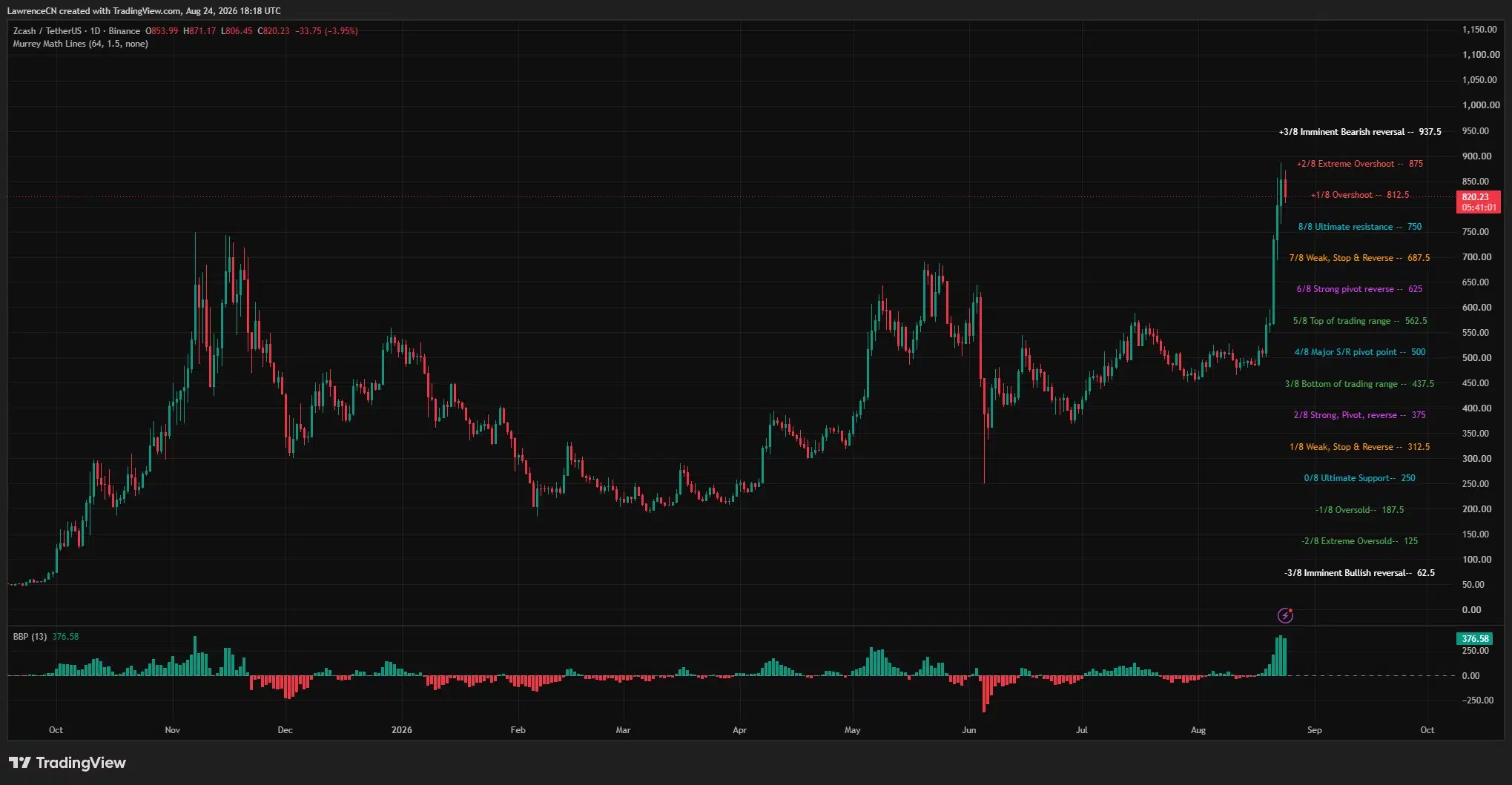
The daily Bull Bear Power reading stood at 376.58, showing that buying pressure remained elevated despite the pullback. However, the size of the indicator’s recent increase also reflects how far and quickly ZEC has moved away from its earlier range.
Grayscale ETF filing adds an institutional catalyst
The price advance followed Grayscale Investments’ latest amended registration statement for the Grayscale Zcash Trust.
Grayscale is seeking to convert the existing trust into an exchange-traded product expected to trade on NYSE Arca under the ticker ZCSH. An accompanying filing said shares were anticipated to begin trading on or around August 25, subject to regulatory approvals.
The proposed structure would give eligible US investors exposure to ZEC through a regulated brokerage product without requiring them to hold the token directly. The registration statement does not mean the SEC has approved the conversion, and the planned listing date remains subject to completion of the regulatory process.
The filing also disclosed non-binding discussions involving DCG International Investments Ltd., a Digital Currency Group subsidiary. Under the potential transaction, the company could contribute about 200,000 ZEC to the trust in exchange for shares.
At the valuation cited when the amendment was reported, the proposed contribution was worth approximately $110 million. The filing describes the transaction as being under discussion, meaning it should not be treated as a completed ZEC purchase or confirmed capital allocation.
Grayscale reported that the trust had about $263.5 million in assets under management as of August 21. The proposed conversion would bring a privacy-focused crypto asset into the US spot ETF market, although Zcash continues to face regulatory and exchange-access risks linked to its privacy features.
NU7 vote follows the Ironwood snapshot
A separate Zcash-specific event may have added demand for shielded ZEC ahead of the rally. According to the NU7 vote announcement on the Zcash Community Forum, Valar Group and Project Tachyon scheduled an approximately 18-day coinholder vote beginning August 25.
Voting eligibility was based on spendable, shielded ZEC held in the Ironwood pool at mainnet block height 3,459,350. The snapshot was expected at approximately 19:00 UTC on August 24, after which holders could move their funds without losing their voting rights.
Voting is scheduled to close on September 14 at 19:00 UTC. The process requires at least 1 million eligible ZEC to meet its minimum participation threshold, while supported wallets allow holders to vote privately and publish only aggregated results.
The ballot will help determine the scope of the planned NU7 network upgrade, including possible changes to Zcash’s issuance schedule and block-production model. The snapshot may have encouraged some holders to transfer tokens into the Ironwood shielded pool, but available data does not establish how much of the price increase came directly from voting-related transfers.
Zcash price faces resistance at $875
The 4-hour chart shows that ZEC remains above the Bollinger Bands’ middle line near $803.35. Holding that level would keep the short-term breakout structure intact, while a sustained drop below it could expose the psychological $800 level.
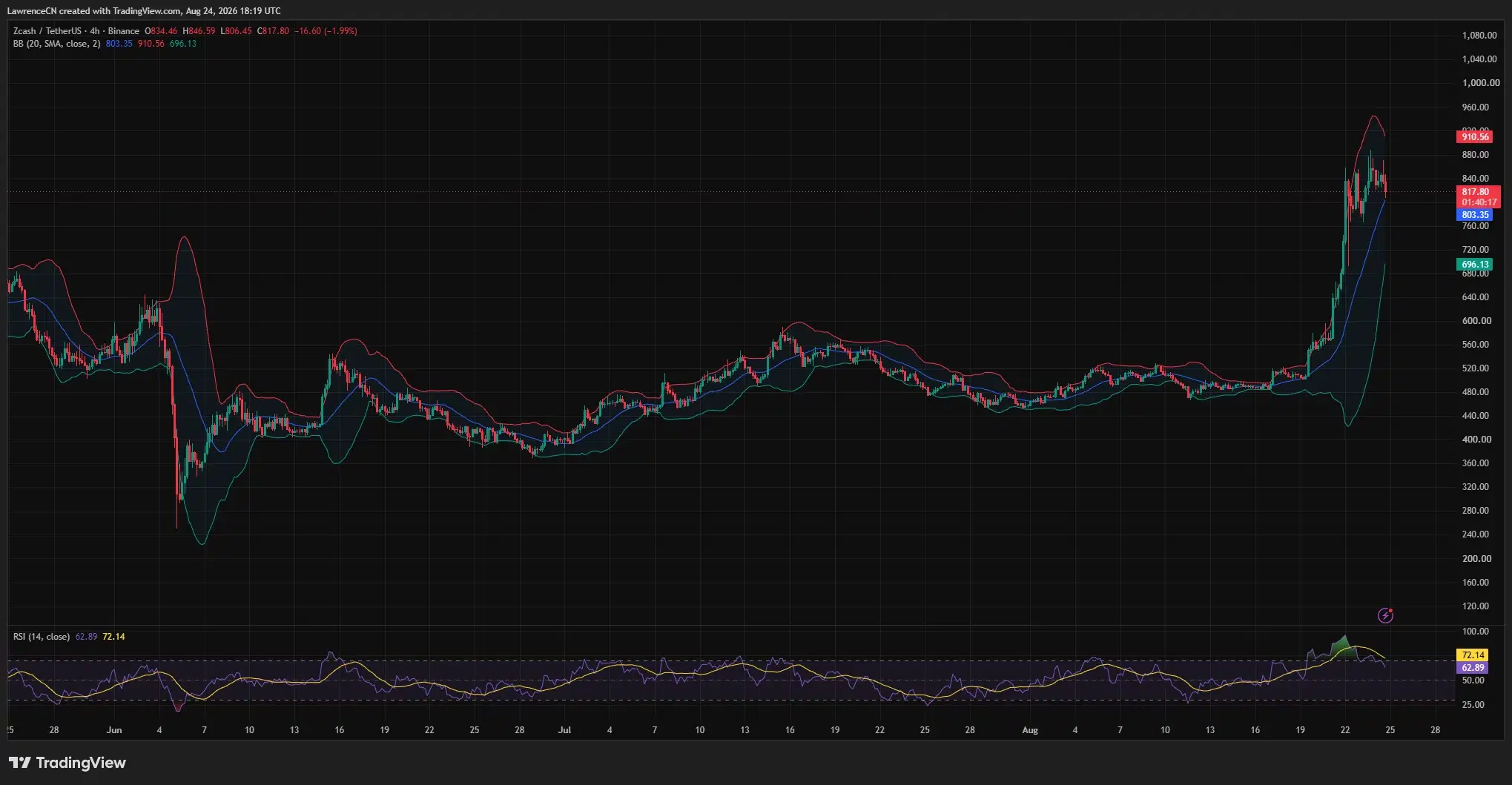
ZEC’s 4-hour Relative Strength Index fell to 62.89 after previously moving into overbought territory. The indicator’s moving average remained higher at 72.14, suggesting that momentum has cooled as the price pulled back from its peak.
The first upside barrier sits between $870 and $875. The daily Murrey Math chart marks $875 as an extreme overshoot level, while the upper 4-hour Bollinger Band stands near $910.56.
A decisive close above $875 could allow buyers to test $910 and then $937.50. The latter is identified on the daily chart as a zone where the risk of a bearish reversal may increase.
On the downside, $812.50 is the first key level to monitor. ZEC was trading only slightly above that line at the time of the chart capture, making it the immediate test for buyers after the intraday reversal.
Below $812.50, the Bollinger midpoint near $803 and the former breakout level at $750 provide the next support areas. A fall below $750 would weaken the breakout and could open a deeper correction toward $696 and $687.50.
Liquidation clusters could increase ZEC volatility
CoinGlass’ 24-hour liquidation heatmap showed concentrated leveraged positions on both sides of ZEC’s market price.

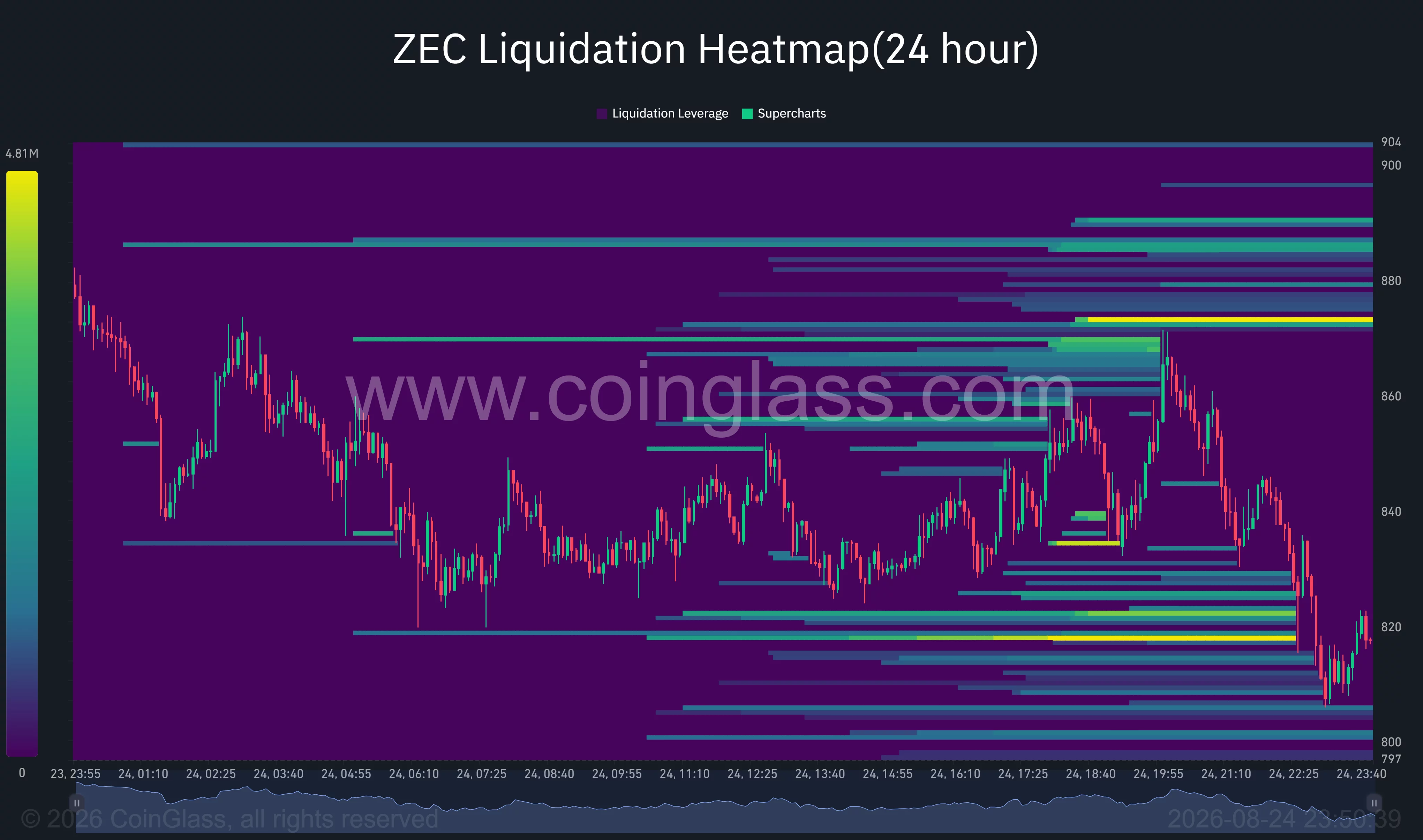
The largest nearby upside liquidity cluster appeared around $872 to $874, matching the chart’s immediate resistance zone. Additional liquidation levels were visible around $882 to $886, which could attract price if ZEC regains upward momentum.
Below the market, a strong concentration appeared near $818 to $820, with further liquidity around $808 and $800. ZEC briefly moved toward these lower clusters during its late-session decline before rebounding above $817.
Liquidation heatmaps show where leveraged positions may face forced closure, but they do not predict which level the price will reach first. With ZEC trading between dense clusters near $800 and $875 after a weekly gain exceeding 70%, a sharp move in either direction could trigger another round of liquidations.
Disclosure: This article does not represent investment advice. The content and materials featured on this page are for educational purposes only.