
Ethereum price lacks conviction as weak volume and failed follow-through increase the risk of a deeper correction toward $2,200 unless buyers step in to defend key support zones.
Summary
- ETH struggles to reclaim the value area high due to thin bullish volume.
- Losing $2,800 opens the door to the untapped $2,200 support.
- Market structure remains range-bound, with downside momentum building.
Ethereum (ETH) price is showing signs of weakness despite its recent bounce, with price action struggling to gain traction above key technical levels. The rally has not been supported by strong bullish volume, raising concerns that the move may lack the momentum needed for sustained continuation.
With the price unable to decisively break above the value area high, Ethereum now faces the possibility of a reversal toward lower support zones. Traders are watching closely as structural signals point toward growing downside risk, particularly if critical support fails to hold.
Ethereum price key technical points
- Ethereum’s rebound is occurring on low volume, signaling weak buyer participation.
- Failure to reclaim the value area high increases the risk of a move toward $2,800 support.
- A breakdown of $2,800 would expose the next support zone at $2,200.

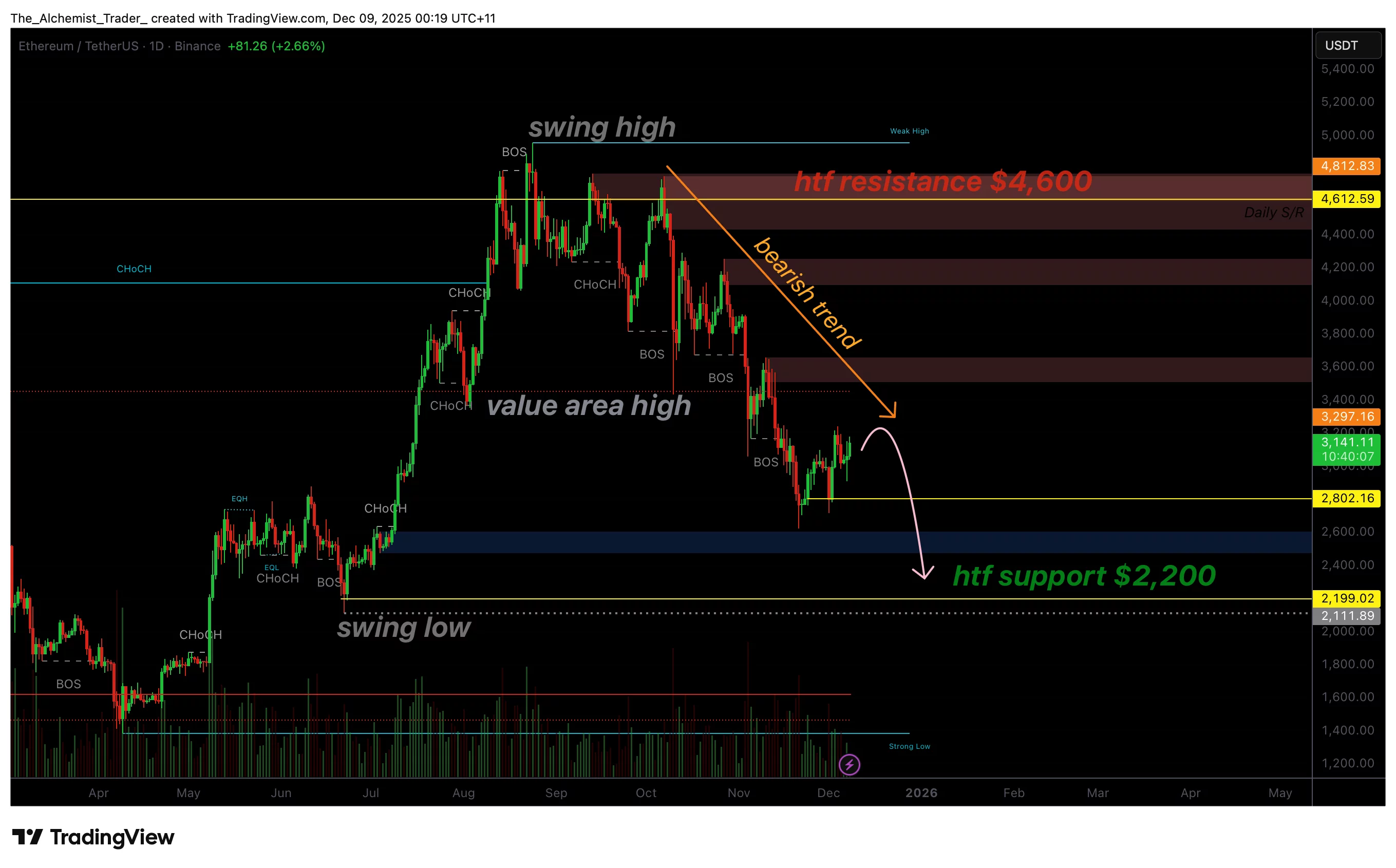
The current bounce on Ethereum has exhibited little strength, struggling to create meaningful follow-through above the value area high. This region serves as an indicator of whether the price can sustain upward expansion or remains confined within its broader range. In Ethereum’s case, the inability to push above this threshold suggests that bullish momentum is lacking.
The weakness is further highlighted by Ethereum ETFs recording over $75 million in outflows with zero inflows, signaling fading institutional appetite as ETH stalls around $3,000. One of the first areas of interest is the $2,800 support level, which has acted as a structural pivot in recent months.
If Ethereum fails to hold $2,800, the probability of a deeper correction increases significantly. Beneath this level lies the $2,200 region, a key support area that has not been revisited since June. This zone contains resting liquidity and represents a natural downside magnet if the market begins to unwind. A sweep of this liquidity could accelerate downward pressure and complete a full rotation within Ethereum’s broader trading range.
It is also important to consider the repeated lack of follow-through in recent bullish attempts. Several countertrend rallies have formed, yet none have managed to break the structure or invalidate the broader downtrend. Each attempt has been met with sell pressure, pushing the price back into the lower half of the range. This series of failed moves further confirms the absence of meaningful buyer commitment.
The long-term structure remains intact within this high-time-frame range, with price oscillating between support and resistance zones for several years. Until Ethereum shows decisive breakout strength, it is likely to continue trading within this larger pattern. This means both rallies and declines are constrained by well-established boundaries, making volume and momentum key indicators for anticipating directional moves.
This broader stagnation mirrors wider market conditions as NFT sales remain modest at $77 million, and Ethereum-based NFTs dropped 13 percent, underscoring the reduced enthusiasm across the ecosystem.
Currently, those indicators lean bearish. With weakening momentum, thin volume on the bounce and no structural break to the upside, Ethereum faces elevated downside risk. A reclaim and close above the value area high would be needed to reverse this short-term bearish bias. Without such confirmation, the path toward $2,200 remains a technical possibility.
What to expect in the coming price action
If Ethereum fails to hold $2,800 and cannot generate bullish volume, the price is likely to rotate toward the $2,200 support level. Only a decisive breakout above the value area high with volume confirmation would negate this bearish scenario.