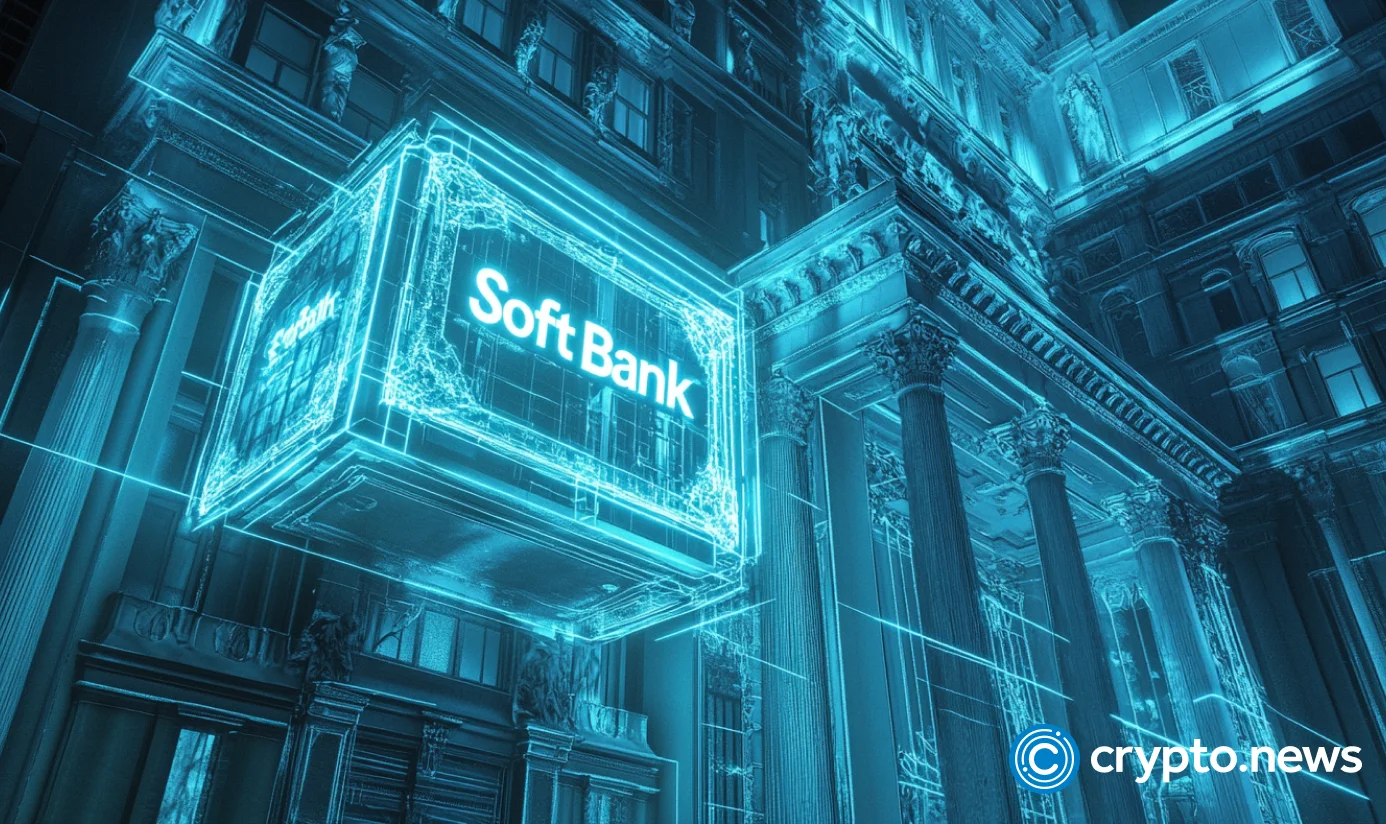

SoftBank is reportedly weighing up to $30B more for OpenAI in a $100B round valuing the AI firm near $830B, deepening their Stargate data center and SB Energy push.
Summary
- SoftBank is in talks to invest as much as $30 billion more in OpenAI as part of a potential $100 billion funding round that could value the company around $830 billion.
- The new cash would build on SoftBank’s roughly $41 billion December investment for an 11% OpenAI stake, cementing Masayoshi Son’s all‑in AI strategy.
- SoftBank and OpenAI are also co‑investors in the $500 billion Stargate AI data center program via a $1 billion SB Energy deal, seen as critical to U.S. AI competitiveness.
SoftBank Group is in discussions to invest up to $30 billion more in OpenAI, according to a Wall Street Journal report published last week.
CoinGecko’s Artificial Intelligence (AI) category currently sits at about $31.6 billion in total market cap, with roughly $2.4 billion in 24‑hour trading volume and a positive 2.7% daily move, making it a meaningful but still niche slice of the roughly multi‑trillion‑dollar crypto market.
While the multi-billion dollar deal may mean big bucks for OpenAI, how the crypoto sector is fragmented across sub‑verticals such as AI agents, data and infrastructure, and application-layer tokens, with capital rotating quickly between narratives like decentralized GPU networks, agent frameworks and biometric identity as new use cases and partnerships have emerged.
Details of landmark OpenAI and SoftBank deal emerge
The potential investment could be part of a funding round that would raise $100 billion and value the artificial intelligence company at approximately $830 billion, the report stated.
The additional investment would follow SoftBank’s December commitment of $41 billion, which gave the Japanese conglomerate an 11% stake in OpenAI, according to the report.
SoftBank CEO Masayoshi Son has pursued an aggressive strategy to strengthen the company’s position in the artificial intelligence sector amid rising competition from rivals including Alphabet, the report said.
OpenAI faces growing costs for training and running its AI models, driven by rapid adoption and the launch of increasingly sophisticated AI systems, according to industry analysts.
Both SoftBank and OpenAI are investors in Stargate, a $500 billion project to build AI data centers designed to support large-scale training and inference operations. Project executives have stated the infrastructure is key to U.S. competitiveness in AI against China.
SoftBank declined to comment on the discussions when contacted by the Wall Street Journal.
The talks signal the company’s continued commitment to OpenAI, which has become a central component of its AI strategy, the report noted. Other Vision Fund deals have slowed as the company focuses resources on the OpenAI investment, according to the report.
OpenAI and SoftBank deal, what does it mean for AI cryptos?
Worldcoin (WLD): biometric ID + AI upside
Worldcoin’s WLD (WLD) token has surged on reports OpenAI may use iris-based verification for a bot-free social platform, turning it into a high-beta proxy on AI identity demand.
- Price action: WLD recently jumped more than 15% in a single session as traders priced in potential integration and renewed speculative flows into AI–ID plays.
- Structural driver: if OpenAI or other large AI platforms adopt Worldcoin’s proof-of-personhood rails, WLD could see sustained on-chain activity rather than one-off news spikes.
- Risk: regulatory pressure around biometrics, privacy, and data localization could cap upside or slow network growth despite narrative strength.
Fetch.ai (FET): autonomous agents and AI middleware
Fetch.ai’s FET (FET) token tracks adoption of its agentic compute stack, where autonomous economic agents automate tasks and transact on-chain.
- Price action: FET typically outperforms in AI risk-on phases as investors rotate into “picks-and-shovels” narratives around agent frameworks and on-chain AI services.
- Structural driver: real usage of Fetch agents in logistics, DeFi automation, or data markets can translate into recurring demand for FET to pay for transactions and services.
- Risk: competition from other AI middleware and L2s building native agent frameworks could dilute the narrative if Fetch fails to land visible enterprise or ecosystem integrations.
Render (RNDR): GPU liquidity for AI
Render’s RNDR (RNDR) token is levered to GPU scarcity, giving holders exposure to decentralized rendering and AI compute demand.
- Price action: RNDR has tended to rally alongside AI-chip names and major model launches, as markets bet on persistent GPU bottlenecks and the need for distributed rendering power.
- Structural driver: if AI training and inference workloads continue to fragment across clouds and DePIN networks, Render’s marketplace model can translate higher GPU utilization into RNDR demand.
- Risk: competition from centralized cloud providers and other DePIN GPU networks could compress margins and weaken the link between AI capex booms and RNDR performance over time.