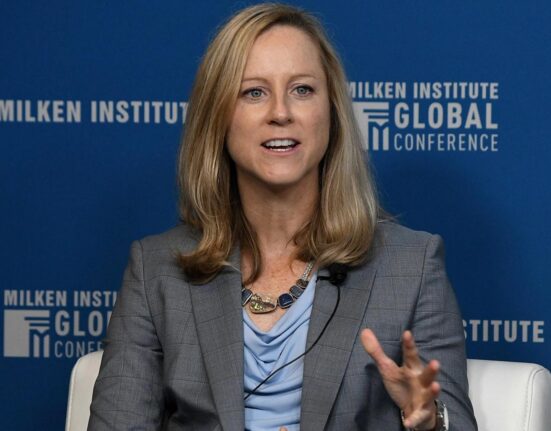


On July 8, Paul Grewal notified Coinbase that he was resigning as chief legal officer and corporate secretary, effective July 31. The company disclosed the departure in an 8-K filing the next day, and by Thursday evening the announcement had rolled through crypto media with the tone usually reserved for a retiring general. Grewal will move into an advisory role from August 1 through October 31, collect a lump sum equal to 3 months of base salary when the advisory period ends, keep the restricted stock units scheduled to vest on August 20, and remain on the board of Coinbase National Trust Company, the entity behind the company’s federal trust charter push at the Office of the Comptroller of the Currency. He says he is joining a startup he has not named.
Summary
- Paul Grewal is leaving Coinbase as chief legal officer just weeks before the Senate’s decisive CLARITY Act vote.
- The article examines Grewal’s role in Coinbase’s legal victories and why the industry’s biggest regulatory battle is shifting from courts to Congress.
- Coinbase’s leadership reshuffle signals a move from defending crypto in court to building regulated financial products.
The timing is the story. Grewal leaves at the end of the very month in which the CLARITY Act, the market structure bill he spent years advocating, faces its decisive Senate window. A merged draft is expected the week of July 13. Floor action is targeted for the week of July 20. The Senate breaks on August 7, and most analysts treat that recess as the effective deadline for passage in 2026. The lawyer who fought the Securities and Exchange Commission to a standstill is walking out of the command tent 2 weeks before the armistice vote.
That reading makes for a good headline, and it deserves an immediate correction: nothing in the record suggests Grewal is fleeing a losing fight. The more interesting question is the opposite one. What does it mean when the most consequential legal officer in crypto decides his work is finished before the law that would ratify it exists? The answer says a great deal about where Coinbase thinks the industry now stands, and about how much of the legal war was actually won in courtrooms versus how much still hangs on 7 undecided Democratic senators.
Six years that defined a legal era
Grewal arrived at Coinbase in the summer of 2020, hired away from Facebook, where he served as vice president and deputy general counsel, to replace Brian Brooks as the company’s top lawyer. Before Silicon Valley, he sat as a federal magistrate judge in the Northern District of California, a background that shaped the posture Coinbase would become famous for: when the government came, the company would not settle quietly. It would litigate, publicly and on principle.
His first major assignment was taking the company public. Coinbase listed on Nasdaq in April 2021 through a direct listing, the first crypto exchange to reach American public markets, a process that required convincing securities lawyers, auditors, and a skeptical SEC review apparatus that a crypto business could meet public company standards. The listing gave Coinbase a currency, a disclosure regime, and a legitimacy that would matter enormously in the fights ahead.
The defining fight arrived in June 2023, when the SEC under Chair Gary Gensler sued Coinbase, alleging the company operated as an unregistered securities exchange, broker, and clearing agency. Legal observers widely described the case as existential, not just for Coinbase but for the American crypto industry, because the theory behind it would have swept most token trading into the securities regime by enforcement rather than by rulemaking. Grewal ran the defense and paired it with offense.
Coinbase petitioned the SEC to write actual crypto rules, then sued when the agency refused. It fought in court to unearth internal SEC documents about the agency’s approach to the asset class. It moved its legal domicile from Delaware to Texas. And it poured resources into the political layer, with Coinbase becoming one of the largest funders of the Fairshake political apparatus, contributing $25 million alongside matching amounts from Ripple and Andreessen Horowitz.
The endgame came after the 2024 election. The SEC under new leadership dropped the Coinbase case in 2025, part of a broad retreat from the enforcement-first strategy, and the industry pivot from courtrooms to Congress produced the GENIUS Act for stablecoins, a fight crypto.news chronicled through its own bruising Senate negotiation, and then the CLARITY Act for market structure.
Grewal’s own summary, posted on X, was uncharacteristically sweeping: after helping take the company public, fighting the SEC and winning, moving the company from Delaware to Texas, and working to get GENIUS and soon CLARITY passed into law, now was his time for new adventures. He called leading the legal team through the biggest fight of the industry the single greatest achievement of his 6-year tenure.
It is hard to argue with the scoreboard. When Grewal joined, the American legal question was whether the industry would survive its regulator. When he resigned, the question was which of two friendly regulators would supervise it.
Anatomy of the SEC fight, and why it mattered beyond Coinbase
The Coinbase case deserves a closer look, because its mechanics explain both Grewal’s reputation and the industry’s current legislative posture.
The SEC’s June 2023 complaint was not a fraud case. It alleged no theft, no misrepresentation, no customer harm. The theory was structural: that a large share of the tokens trading on Coinbase were unregistered securities, which made Coinbase itself an unregistered exchange, broker, and clearing agency all at once. If that theory prevailed, every American platform listing those tokens faced the same triple liability, and registration was not a realistic cure because the SEC’s existing forms and rules were written for equities and had no workable application to token markets. The industry read the suit as an attempt to regulate by enforcement what the agency declined to address by rulemaking, and Coinbase built its defense around exactly that asymmetry.
Grewal’s strategic insight was to refuse the defendant’s crouch. Coinbase had already filed a rulemaking petition in July 2022 asking the SEC to write crypto-specific rules. When the agency ignored it, Coinbase sued to compel a response, eventually winning a court order forcing the SEC to explain itself, and an appellate rebuke when the explanation proved thin. In the main enforcement case, the company pursued discovery into the agency’s internal deliberations, seeking documents about how officials themselves discussed token classification, a move that transformed the lawsuit from a compliance dispute into an examination of the regulator’s own consistency. The judge in the Southern District of New York allowed core claims to proceed but also certified questions that exposed how unsettled the doctrine was. None of this guaranteed victory. What it did was raise the cost of the SEC’s strategy, publicly and procedurally, until a change of administration made retreat the path of least resistance.
The dismissal in 2025 was, as observers noted at the time, a massive win for Grewal, Coinbase, and the industry. It was also, and this is the part that matters for July 2026, a win by default. The core legal question, which tokens are securities and under what test, was never answered by a controlling appellate decision. The SEC withdrew; the doctrine did not change. That unfinished quality is why Coinbase pivoted its entire public affairs machine toward Congress, and why Grewal spent his final 18 months as much in Washington as in court. The company understood that it had won a battle of attrition, not a ruling it could cite forever.
The political arm of that pivot operated at a scale American finance had rarely seen from a single company. Coinbase became one of the top corporate political donors of the 2026 midterm cycle, with disclosed contributions exceeding $35 million by some tallies, most of it flowing through the Fairshake network of political action committees, which entered the year with roughly $193 million on hand. Whatever one thinks of that spending, it purchased something litigation never could: a House that passed the CLARITY Act 294 to 134 in July 2025, and a Senate Banking Committee that advanced it 15-9 in May 2026, as crypto.news has tracked through every procedural turn since.
The succession, and what it signals
Coinbase paired the departure with a reorganization that reveals how the company sees its next phase. Molly Abraham, a vice president of legal who joined Coinbase in March 2021 and previously served as general counsel of an electric aircraft startup, becomes general counsel and corporate secretary. Ryan VanGrack, another legal vice president who ran much of Coinbase’s courtroom strategy and previously served as general counsel at Citadel Securities, takes a newly created post as vice chairman and head of corporate affairs, a public-facing role focused on governments, regulators, and industry relationships worldwide. Faryar Shirzad continues as chief policy officer, keeping the Washington operation under unchanged leadership through the CLARITY endgame.
Read the org chart as a statement. The general counsel role goes to an operator whose framing of the moment, in her own words, is that the next chapter is all about building products. The combat portfolio, the part of the job that made Grewal a public figure, gets split into a diplomatic post for VanGrack and an unchanged policy shop under Shirzad. Coinbase is reorganizing its legal function from a war department into a foreign ministry, which is exactly what a company does when it believes the shooting war is over.
The market agreed, or at least did not object. COIN barely moved on the news, a nonreaction worth pausing on. A chief legal officer departing a company whose valuation spent years hostage to litigation risk would once have been a sell signal. In July 2026 it was a footnote, which is itself a measure of how thoroughly the legal overhang has drained out of the stock. The shares have other problems, trading around $165, closer to their 52-week low near $139 than to the high above $444, but those problems are market beta and revenue mix, not subpoenas.
There is also continuity where it counts. Grewal keeps his seat on the board of Coinbase National Trust Company and will keep working on the OCC trust charter, which received conditional approval earlier this year. The charter is arguably the most important regulatory project Coinbase has left, a federal banking-adjacent license that would anchor its custody and payments ambitions, and the company is keeping its most experienced regulatory hand attached to precisely that file.
The war that is not actually over
Here is the counterargument, and it is not a strawman: the general is leaving before the war ends, because the war has not ended.
The CLARITY Act is not law. It is a bill that needs 60 Senate votes and currently commands, by the most generous count, 55. The merged Banking and Agriculture text, reportedly more than 70 pages longer than earlier versions, has not been released. The ethics dispute over the Trump family’s estimated $2.3 billion in crypto holdings has broken multiple tentative compromises, and Democrats including Kirsten Gillibrand have said flatly that there is no bill without an ethics provision.
Even the two Democrats who advanced the bill in committee, Ruben Gallego and Angela Alsobrooks, have conditioned their floor votes on that fix. Law enforcement groups are fighting the developer protection language, a split crypto.news examined in detail, and a separate standoff over vacant SEC and CFTC commissioner seats has produced an amendment from Senator Amy Klobuchar that would freeze the new CFTC rulebook until 4 commissioners are confirmed. Galaxy Research puts 2026 passage at 50%. A coin flip is not a victory parade.
And the legal victories Grewal won are, in a strict sense, reversible. The SEC dropped its case; it did not lose a final judgment on the merits at the appellate level. The agency’s current posture is a policy choice by the current commission, formalized in an administrative framework that Chair Paul Atkins himself calls a bridge to legislation. A bridge built by one commission can be dismantled by the next. The entire argument for the CLARITY Act, made loudest by Coinbase itself, is that enforcement peace without statute is a ceasefire, not a treaty. By that logic, the company’s chief legal officer is departing during the ceasefire, with the treaty unsigned.
The rebuttal to the rebuttal is about comparative advantage. The remaining work is legislative, and Grewal was never the legislative arm. Shirzad runs policy. Fairshake and the industry coalition run the political money, with Coinbase reportedly among the largest corporate political donors of the 2026 cycle.
The final 3 weeks of the CLARITY fight will be decided by Senate floor mechanics, White House ethics negotiations, and 7 individual Democratic calculations, none of which a chief legal officer controls. What a chief legal officer controls, litigation posture against the SEC, is precisely the front that went quiet. On the battlefield where Grewal fought, the war really is over. On the battlefield where it continues, he was always a supporting actor.
What Coinbase is becoming without him
The company Grewal leaves behind is deliberately outgrowing the category he defended. Over the past year Coinbase has launched stock and ETF trading for all US users on a 24/5 schedule, partnered with Yahoo Finance to pipe research traffic into trades, agreed to acquire The Clearing Company to build regulated prediction markets, rolled out perpetual-style futures through its CFTC-regulated derivatives arm, secured a UK investment services authorization to add equities and derivatives for British users, and pushed deeper into stablecoin infrastructure with custom stablecoin issuance for businesses. Management now describes the goal as the everything exchange, one venue for crypto, equities, derivatives, and prediction markets.
That strategy quietly reframes the legal risk profile. An everything exchange answers to the SEC, the CFTC, the OCC, state regulators, and foreign authorities simultaneously, but it answers to them as a conventional, licensed financial institution, not as a defendant arguing about what a token is. The stakes of token classification shrink as the revenue mix diversifies away from spot crypto trading. In that world, the highest-value legal work is licensing, integration, and regulatory relationship management, which is the portfolio VanGrack and Abraham now split.
The stablecoin business shows the same migration from combat to competition. Coinbase’s economics lean heavily on its USDC arrangement with Circle, and the live threats there are commercial and regulatory-technical: the OCC’s February stablecoin rule extending the GENIUS Act yield ban to affiliates, bank lobby pressure on stablecoin yield that crypto.news has covered as a $6 trillion standoff, and the market share fight in which, as crypto.news reported, USDC has been beating Tether where trading volume actually lives. None of that is litigation. All of it is the next general counsel’s problem.
The risks Coinbase is accepting
A fair accounting has to name what the company gives up, because a transition this clean still carries costs.
The first is institutional memory in a crisis. Abraham has been at Coinbase for more than 5 years and, in Grewal’s words, fought in the trenches on the company’s most important legal battles, so this is not a cold start. But the specific muscle Grewal built, the willingness to sue a federal agency, to litigate discovery against a regulator, to take a public position and absorb the retaliation risk, is a temperament as much as a skill set.
Companies tend to hire for the war they just fought or the peace they expect. If the political environment flips after the 2026 midterms, or after 2028, and a future SEC revives the enforcement playbook against a Coinbase that now touches equities, derivatives, prediction markets, and banking-adjacent custody, the surface area for a hostile regulator is larger than it was in 2023, and the wartime commander will be at a startup.
The second is signaling risk in Washington during the most delicate month of the CLARITY fight. Grewal was one of the industry’s most credible witnesses precisely because he carried a federal judicial pedigree into rooms full of skeptical staffers. His departure does not remove Coinbase from the negotiation; Shirzad’s team remains fully engaged, but it does remove a specific voice at a moment when the bill’s opponents are arguing that the industry seeks impunity, not clarity. Senators reading the news can take it either way: as evidence the industry has matured past its combative phase, or as evidence that the people who understood the fight best are cashing out before the terms are final.
The third is concentration of the remaining legal risk in exactly the areas where Grewal’s successors are least tested. The OCC trust charter, the UK authorization, the Clearing Company acquisition review, and the state-by-state rollout of prediction markets are all licensing and approval processes where the counterpart is a regulator with discretion, not a plaintiff with a burden of proof. Grewal stays attached to the trust charter file, which mitigates the largest single item, but the portfolio as a whole now belongs to a legal team whose public track record is shorter than the ambitions it must clear.
None of these risks is disqualifying, and all of them are the ordinary price of succession. They are worth stating because the alternative narrative, that this transition is costless because the SEC fight ended, quietly assumes the regulatory weather of 2026 is permanent. Nothing in crypto’s history supports that assumption.
The precedent watchers should actually care about
Executive departures in crypto usually mean one of three things: scandal, disagreement, or completion. The filings, the send-off from regulators and industry figures, and the succession design all point to the third. But completion has its own information content, and two audiences should read it carefully.
For the industry, Grewal’s exit marks the formal end of the enforcement era as a career-defining battlefield. The generation of crypto lawyers who made their names fighting the SEC between 2020 and 2025 is dispersing into startups, advisory roles, and policy shops. The next generation will make its name on implementation: CFTC registration regimes, trust charters, MiCA passporting, bank partnerships. That is a less heroic practice, and a far larger one.
For CLARITY watchers, the exit is a mild but real confidence signal. Companies do not let their most famous legal asset walk during a live existential threat. Coinbase’s revealed preference, releasing Grewal to an advisory role while leaving the policy team untouched, says the company assigns low probability to a world where it needs a wartime chief legal officer again soon. It could be wrong. If the bill dies in August and a future administration revives enforcement, this July will look like the moment the industry demobilized early. If the bill passes, it will look like the moment the first company knew.
The calendar Grewal leaves behind is compressed enough to summarize in one paragraph. The week of July 13: the merged CLARITY text arrives, and its ethics language, or the absence of it, sets the tone for everything after. The week of July 20: the targeted floor window, contested by a defense spending bill and dependent on Majority Leader Thune scheduling time. August 7: the recess begins, and with it, by the estimate of Stifel, Galaxy, and Senator Lummis alike, the effective end of the 2026 window.
Somewhere in that stretch, Gallego, Alsobrooks, and at least 5 colleagues decide whether the ethics compromise on offer is defensible back home. Grewal’s last day as chief legal officer, July 31, lands in the middle of the count. If the Senate acts before he clears out his office, the timing that looked like a general leaving early will read instead as a handoff executed at the exact moment the mission is completed. Few executives get to choose their exit that precisely. Fewer still get the legislative calendar to cooperate.
Grewal himself put the stakes of his tenure in terms that will outlast the news cycle: the legal wins helped ensure crypto not only had a future in the United States, but could flourish. The first half of that claim is now hard to dispute. The second half is a bill sitting on the Senate calendar, waiting on a merged draft, an ethics compromise, and 7 votes. The general can leave because the outcome of his war is no longer in doubt. Whether the peace gets written into law is now, fittingly, out of the lawyers’ hands.