MEXC’s average daily stock futures volume in Asia has jumped 3,308% quarter over quarter as crypto users increasingly trade equities, gold and other traditional assets through centralized exchanges.
Summary
- MEXC’s average daily stock futures volume in Asia rose 3,308% during the second quarter.
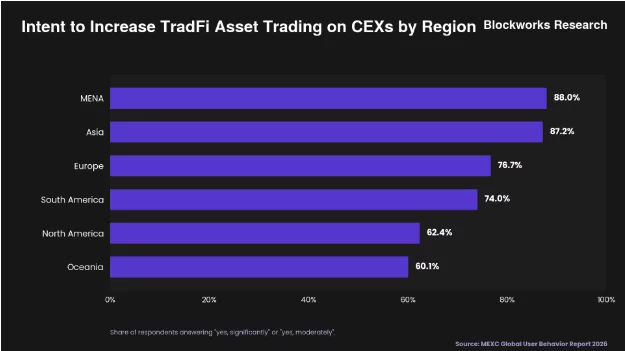
- About 87.2% of surveyed Asian users plan to increase their TradFi trading through CEXs.
- TradFi-linked futures generated nearly $400 billion in trading volume across CEXs during July.
- Limited market hours and brokerage costs are pushing some users toward round-the-clock crypto platforms.
Blockworks Research said in The Cross Asset Shift, a report commissioned by MEXC Ventures, that the exchange’s average daily number of stock futures traders in Asia increased by 386% from the first quarter of 2026.
Trading activity accelerated further in Southeast Asia, where average daily stock futures volume climbed 6,648%, and the number of users rose 399%. East Asia recorded a 1,957% increase in volume and a 465% rise in traders during the same period.
Momentum continued into the third quarter. Through August, MEXC’s average daily stock futures volume across Asia had risen another 102% from the second quarter, while the number of users increased 51%. East Asian volume climbed 186%, compared with a 50% increase in Southeast Asia.
The report combined Blockworks Research exchange data with a survey of MEXC users and the exchange’s Asian platform figures. MEXC Ventures commissioned the study, while Blockworks said its researchers retained editorial control over the finished report.
MEXC stock futures have become the main TradFi entry point
Futures have attracted much more activity than spot products among crypto traders seeking exposure to traditional markets, according to the report. Real-world assets, foreign exchange, and tokenized stocks account for less than 2% of monthly spot volume on centralized exchanges but more than 12% of futures volume.
In July, futures tied to the three categories generated close to $400 billion, the highest monthly total in the period reviewed. Tokenized stock contracts supplied most of the recent growth, with Binance leading the segment and MEXC and BingX each controlling about 20% of volume.
MEXC processed $427 million in spot tokenized-stock volume during July, placing it behind Bybit, Gate and Binance. Combined spot trading in tokenized stocks, foreign exchange and RWAs reached about $9.5 billion, down from more than $30 billion in October 2025.
The gap indicates that traders are mostly using leveraged contracts rather than buying spot representations of the assets. Perpetual futures let users take long or short positions without an expiry date, although leverage can increase losses and expose a position to liquidation.
Earlier exchange data offered a similar picture. A CoinGecko report covered by crypto.news in July ranked MEXC second in TradFi perpetual trading volume, with $323.86 billion recorded between January 2025 and May 2026.
CoinGecko also placed MEXC first for product coverage among the exchanges it studied. The platform listed 199 RWA spot products and 159 TradFi perpetual contracts during the measured period, bringing its total to 358.
Asian crypto users are moving from digital assets into stocks and gold
Among crypto-native Asian respondents, 62.6% said they primarily traded precious metals through centralized exchanges, the highest share among the regions surveyed. About 87.2% said they intended to increase their TradFi activity on such platforms.

Stock spot markets are also gaining users, although their volume remains much smaller than that of futures. In Southeast Asia, the average daily number of MEXC users trading spot stocks rose 153% during the second quarter, while average daily volume increased 348%.
During the third quarter through August, the region’s daily spot user count grew another 159% from the previous quarter, and volume increased 87%.
Existing crypto use has made the move between asset classes easier for many Asian traders. Citing regional blockchain data, Blockworks Research said the value received on-chain across Asia-Pacific increased 69% year over year during the 12 months ending June 2025, the fastest rate among the regions compared.
Monthly on-chain value across Asia-Pacific increased from about $80 billion in July 2022 to almost $245 billion in late 2024. It remained between $185 billion and $230 billion during the first half of 2025.
Stablecoins form another part of the trading infrastructure. Research from the Organisation for Economic Co-operation and Development estimated that Asia accounted for about 30% of worldwide stablecoin activity in 2025.
A user holding USDT on an exchange can move between Bitcoin, stocks, gold, and indices without first sending money to a bank or funding a separate brokerage account. According to the MEXC survey, 83.9% of Asian respondents already relied primarily on CEXs for their cryptocurrency trading.
Performance differences may also have influenced interest in assets outside crypto. From the start of 2025 through the report’s measurement period, Blockworks Research calculated that Bitcoin had fallen 32%, while gold gained 64%, the Nasdaq-100-tracking QQQ rose 42%, and the S&P 500-tracking SPY added 32%.
Gold has given way to faster stock-futures growth
Gold was one of the first traditional assets to build substantial trading activity on crypto exchanges, supported by existing demand from Asian investors. World Gold Council figures cited in the report showed that Asian gold exchange-traded funds added 215 metric tons during the first quarter of 2026 and received $25 billion in net inflows.
On MEXC, average daily gold futures volume in Southeast Asia rose 18% quarter over quarter. The number of daily users trading spot gold increased by 42%, exceeding the growth recorded in East and South Asia.
Precious-metals futures open interest peaked at $1.98 billion in May before easing to $1.69 billion at the end of June. Gold and other precious metals still represented 36.2% of all open positions in TradFi perpetual futures at that point.

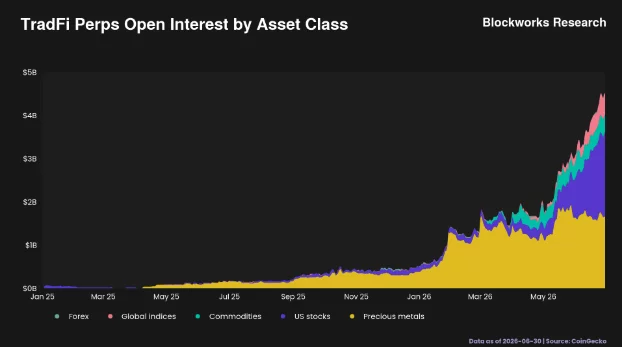
U.S. stock futures moved ahead of precious metals by open interest in June, however, as demand spread to equity-linked contracts. The development followed growing interest in artificial intelligence and memory-chip companies, which attracted traders who had previously concentrated on cryptocurrency markets.
Spot gold has come closer than most traditional assets to achieving a balance between cash and leveraged trading. MEXC’s PAXG markets processed $2.02 billion in spot volume and $2.03 billion in futures volume from January through July 2026. The monthly futures-to-spot ratio remained between 0.8 and 1.6.
Stocks have also gained ground in the tokenized market. In August, Binance bStocks reached $610.6 million in value, while xStocks held $601.2 million, and Ondo Finance remained first in Token Terminal’s issuer ranking.
Round-the-clock trading raises access and risk questions
Traditional market hours remain a central reason cited by Asian users for trading through crypto exchanges. About 61.5% of survey respondents described brokerage trading hours as limited, while 75.1% said they had encountered a major market event when conventional markets were closed.
Faced with a similar event, 79% said they would consider using a crypto platform to open a gold or oil position. The report pointed to the weekend U.S. strikes on Iran in February 2026, when West Texas Intermediate crude gained as much as 15% on Hyperliquid before conventional markets reopened.
Fees and account requirements also affected user choices. Some 53.8% of respondents viewed traditional brokerage costs as high, while 42.6% described account-opening procedures as complex.
For U.S. investors, the availability of continuous tokenized-stock trading remains subject to federal securities rules. The Securities and Exchange Commission has been preparing an exemption that could allow selected platforms to test round-the-clock tokenized securities markets under set conditions.
No final framework, eligibility requirements, or launch date has been announced. SEC officials have maintained that putting a share on a blockchain does not remove it from securities oversight, leaving platforms subject to rules covering registration, custody, trading, settlement and market surveillance.
Product structures can also offer different rights. Some tokenized stocks represent a claim backed by an underlying share, while synthetic contracts may only follow its price and provide no voting or dividend rights. Futures carry separate funding-rate and liquidation risks because traders do not own the referenced stock.
The report listed limited user knowledge as the most common barrier to continued adoption, cited by 51.2% of surveyed Asian users. Market volatility followed at 43.8%, regulatory uncertainty at 37.2%, and liquidity at 36.3%.
Weekend markets create an additional pricing problem because market makers cannot always hedge through the underlying stock or commodity while conventional venues are closed. According to Blockworks Research, carrying the exposure until markets reopen can lead to larger spreads and smaller orders when users seek to trade.