DEXE sank to roughly $1.90 in the past day before ripping past $5 the same session, and the chart says this bounce still has room to run.
DEXE dropped to roughly $1.90 over the past day, a level nobody bidding the token near $40 two weeks ago would have expected. Then it turned around completely.
By the latest print, price sat above $5, up more than 100% from that low and still climbing.
Call it a dead-cat bounce or call it something more. The chart is doing the talking right now.
Fresh low. Sharp reversal. A staircase back up that hasn’t broken stride yet.
Context matters here. DEXE peaked at $48.89 on July 13, then lost most of that value after two project-linked wallets sent millions in tokens to Binance. That story is three days old now. This move is new.

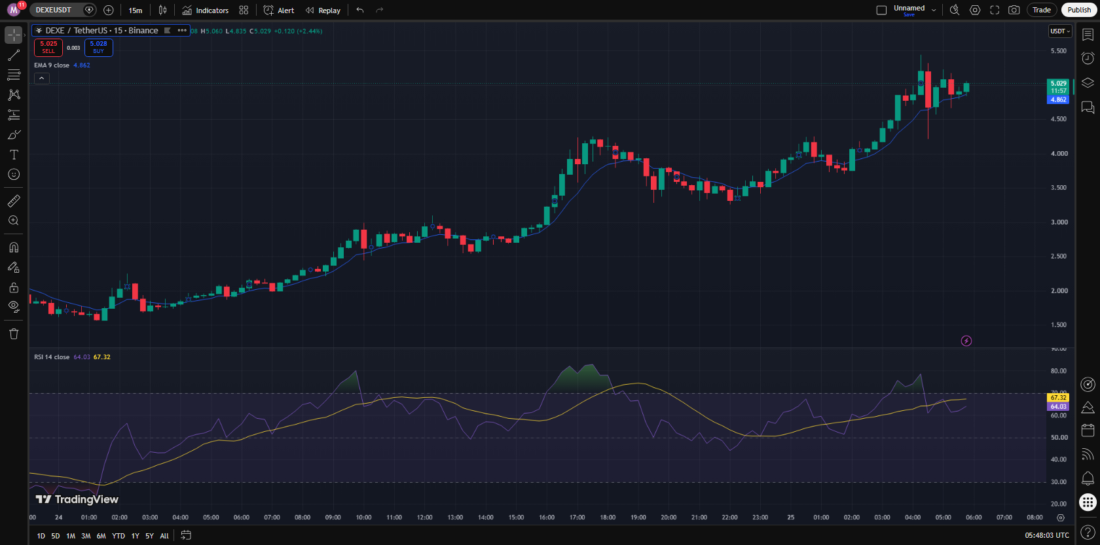
DEXE/USDT 15-minute chart, the reversal off today’s low. Source: TradingView / Binance.
Classical Signals Point to a Real Base
Chart watchers had already flagged a falling wedge on DEXE heading into this week, a pattern where price grinds lower between two converging trendlines. It typically resolves upward once the lower line breaks.
This looks like that break.
EMA-9 crossed back above the candles on the lower timeframes during the move. Every pullback since has bounced off that average instead of closing beneath it. That’s a textbook short-term trend flip, for now at least.
RSI on the 1-hour chart climbed from deep oversold, under 20, all the way to 73 during the sharpest leg of the rally. It brushed overbought territory before cooling into the mid-60s.
Momentum here looks real, not just one green candle doing all the work.
The next real test sits in the $32 to $40 band, the range DEXE spent a full week consolidating in before the July 22 crash. Old support tends to act as resistance on the way back, and that zone remains a long way above current levels.
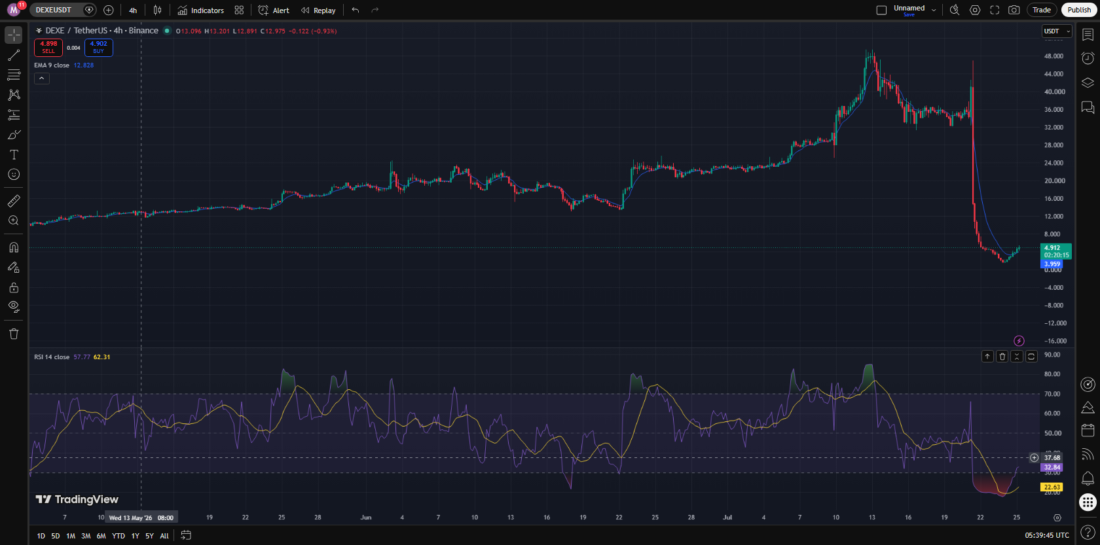
DEXE/USDT 4-hour chart, base through breakdown through today’s base-building. Source: TradingView / Binance.
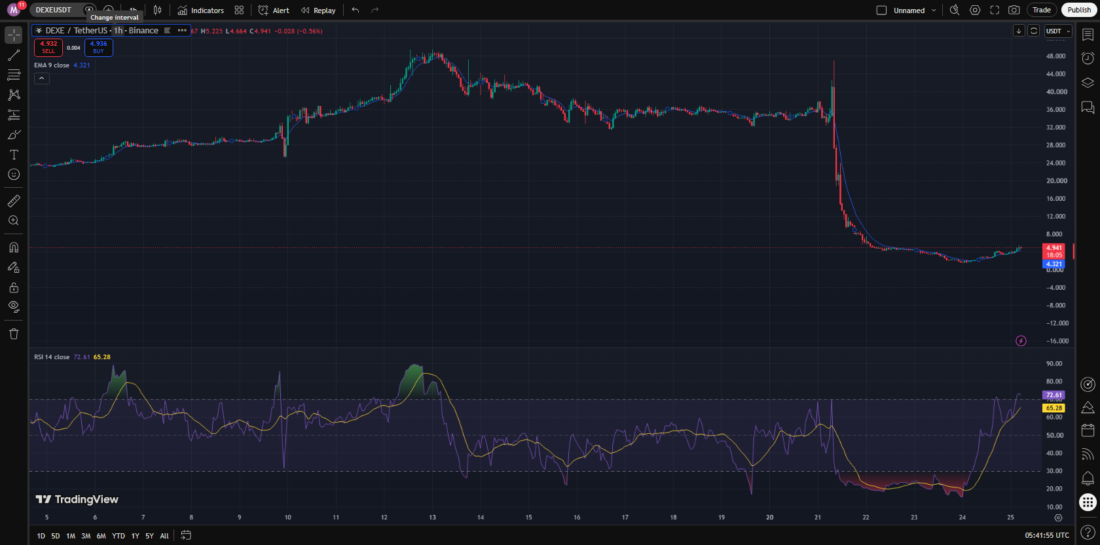
DEXE/USDT 1-hour chart, EMA-9 and RSI recovery from oversold. Source: TradingView / Binance.
Five Waves, Maybe Four and a Half
The move off the February low reads like a textbook impulse through wave three. Call it an extended third wave, the one carrying the bulk of the distance, if you want to be precise.
Wave four unfolded as a full week of sideways chop between roughly thirty-two and forty dollars, July 14 through July 21. That’s a long time for a fourth wave to sit there without ever touching either boundary.
What should come next, in the clean version, is a fifth wave pushing to a marginal high before the real correction starts. Didn’t happen, though.
Price broke straight down out of the range on July 22 instead, and just kept falling, all the way into that fresh low near $1.90. Reads more like the fourth wave never actually finished, or maybe the whole thing topped early, hard to say for sure.
The bounce since that low still has the shape of a B-wave inside a bigger correction, not some brand-new uptrend, at least not yet. If that count holds, a C-wave leg lower is still on the table before this fully resolves, even with how strong today looks.
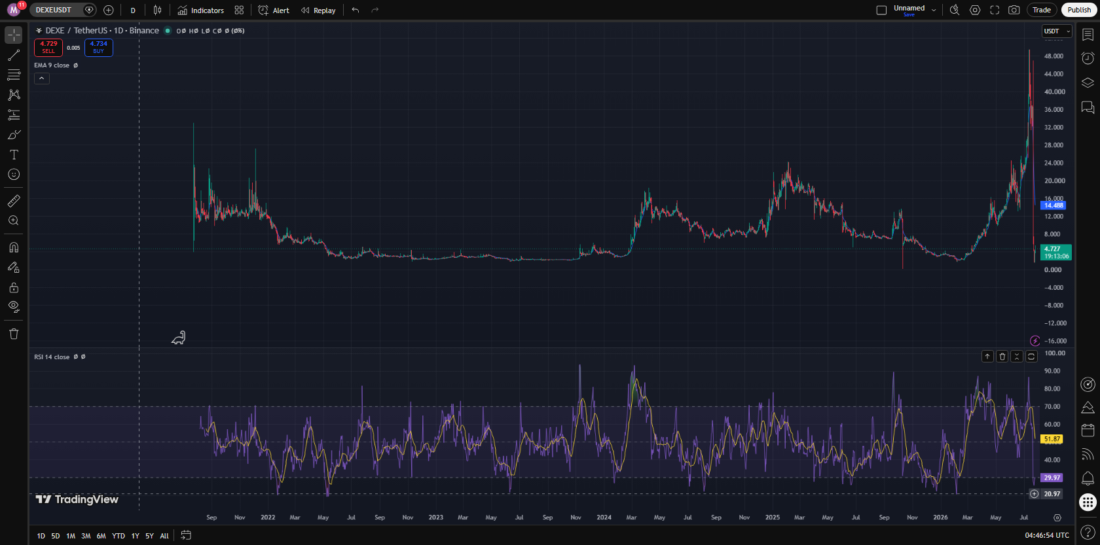
DEXE/USDT daily chart, the full base-to-ATH-to-crash structure. Source: TradingView / Binance.
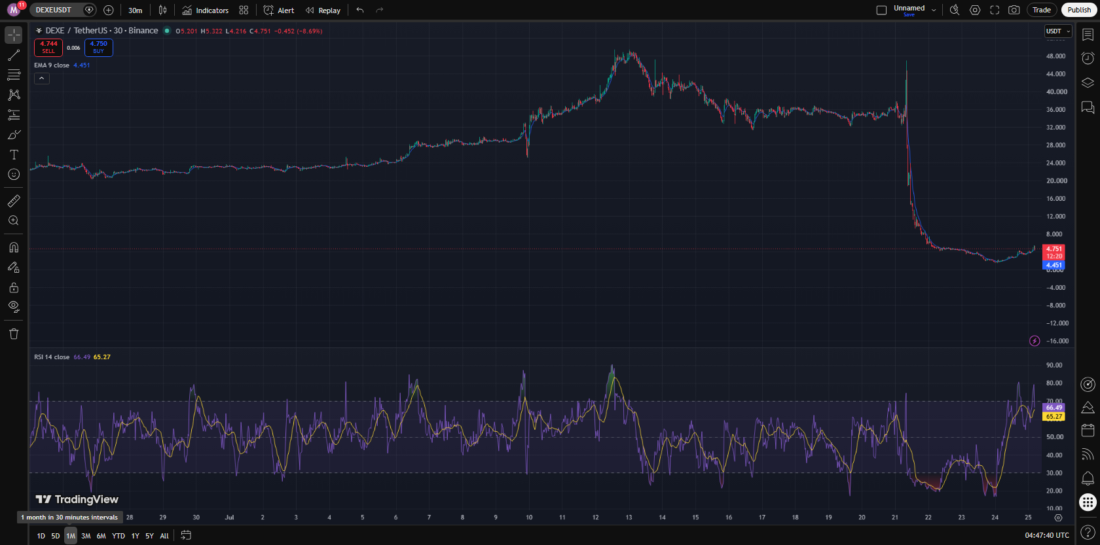
DEXE/USDT 30-minute chart, the wave three extension and wave four range. Source: TradingView / Binance.
The Wallets Moved Fourteen Hours Early
The backdrop to all this matters. Two Gnosis Safe multisig wallets sent a combined 624,999 DEXE to Binance in the hours before the July 22 crash. That’s the kind of wallet structure project teams and treasuries use, not individual traders.
One safe moved 371,309 tokens, worth close to $3.9 million at the time. It went into an intermediate wallet roughly fourteen hours ahead of the drop, which then forwarded most of it to a Binance deposit address.
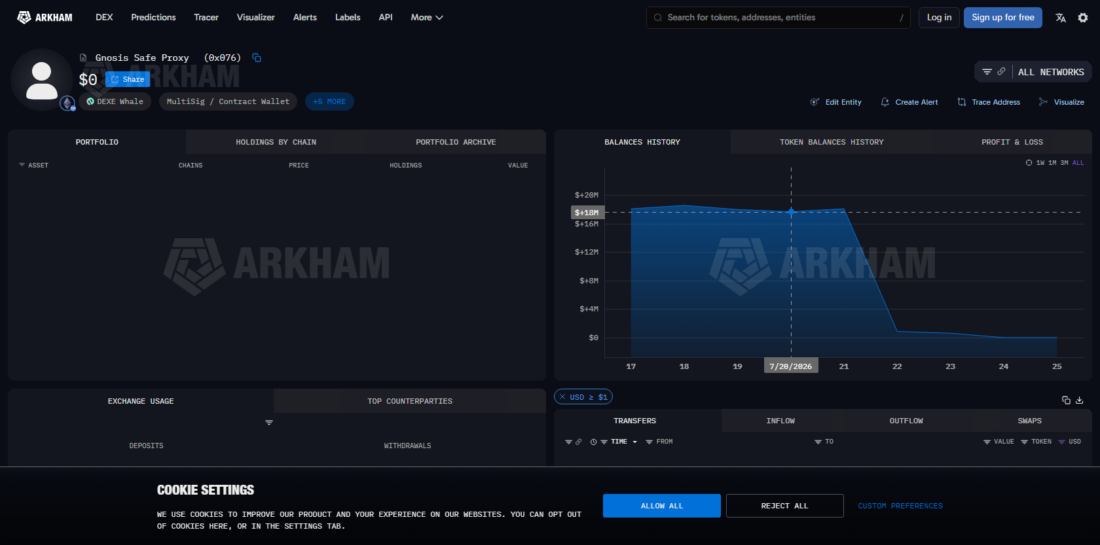
First Gnosis Safe wallet, tagged DEXE Whale. Source: Arkham.
A second safe sent 253,690 DEXE, worth around $2.66 million, through basically the same pattern. Its balance history shows the drop to zero landing right on the crash date.
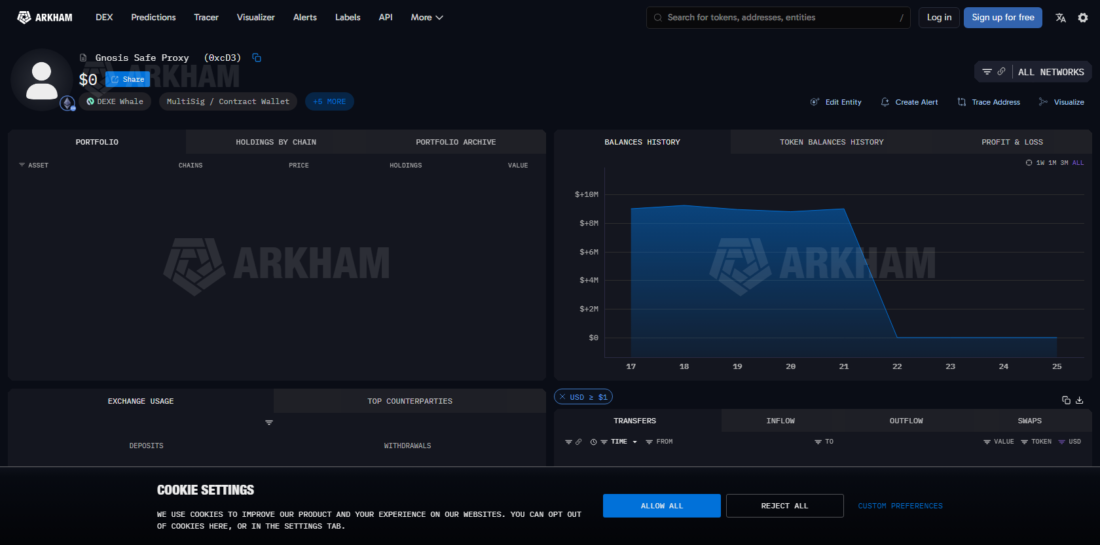
Second Gnosis Safe wallet, balance falling to $0 on July 22. Source: Arkham.
Combined, that’s north of $6 million in project-linked tokens landing on an exchange within hours of each other. Not exactly a coincidence that inspires confidence.
To be fair, the same on-chain activity that fueled suspicion later was flashing bullish two weeks earlier.
Wallet creation spiked hard right around the ChangeNOW listing, honestly one of the biggest single-day counts all year. Transactions above $100,000 hit their fourth-highest daily total in 2026, at least going by what’s on record. Usually that kind of pattern means actual buyers showed up, not bots, though nothing’s ever fully certain with on-chain reads like this.
What Santiment Already Knew
Santiment’s on-chain desk flagged elevated selloff risk for DEXE a full day before the crash. The warning cited large token volumes moving onto exchanges, the kind of flow that leaves any rally fragile until the market actually absorbs it.
No hack, no exploit, nothing on the smart contract side has surfaced since. DeXe’s team never put out a statement addressing the transfers.
Whether that makes it a rug pull or just insiders cashing into a blow-off top probably depends on who gets asked. For anyone who bought near the top, the label barely changes the outcome.
None of this is investment advice. DEXE remains a thinly tracked governance token with a lot of open questions about its emission schedule, and today’s bounce, however sharp, doesn’t erase that.