
BlackRock’s ETHB ETF introduces staking rewards to Ethereum ETFs, giving investors both ETH price exposure and yield from network validation.
BlackRock has introduced a new Ethereum exchange-traded fund designed to generate income from staking. The product trades under the ticker ETHB and expands the firm’s digital asset ETF offerings. Unlike traditional spot Ethereum funds, the new ETF distributes staking rewards to investors. As such, the structure offers both price exposure and yield tied to the Ethereum network.
BlackRock’s ETHB Offers Monthly Staking Income for ETF Investors
According to ETF analyst James Seyffart, the fund follows a structure similar to BlackRock’s existing Ethereum ETF. However, ETHB includes a staking component that sets it apart from other ETH-based tokens. Part of the Ether held by the fund will participate in network validation activities.
NEW: BlackRock is launching their Ethereum Staking ETF today — $ETHB. It will have the same fee as $ETHA at 0.25% bps but has a fee waiver down to 0.12% for the first year or first $2.5 billion in assets. pic.twitter.com/aR3FVRChPz
— James Seyffart (@JSeyff) March 12, 2026
ETHB carries a 0.25% expense ratio, matching the fee charged by the firm’s spot Ethereum ETF. Early investors will receive a temporary fee reduction. Costs will drop to 0.12% for the first year or until assets reach $2.5 billion.
Staking rewards earned from the network will be converted into cash and paid to investors as dividends. Seyffart noted that these payments could occur on a monthly basis. In turn, the structure allows investors to receive staking income without managing validators or technical infrastructure.
BlackRock ETF Structure Uses Multiple Validators for Ethereum Staking
Part of the fund’s Ether holdings will be allocated to validators operating on the Ethereum network. Validators process transactions and maintain blockchain security while earning rewards from the network. Those rewards form the income stream distributed to ETF shareholders.
Meanwhile, several institutional providers will support the staking infrastructure. Coinbase will serve as both the custodian and staking provider for the ETF. The company will handle asset storage as well as validator operations. Approved validator providers include Figment, Galaxy Digital, and Attestant.
Attestant was recently acquired by Bitwise Asset Management and is now being rebranded as Bitwise Onchain Solutions. Together, these providers will manage validator onboarding and staking operations.
Oversight of staking activities will involve the trust’s prime execution agent alongside the Ether custodian. That structure coordinates validator selection and staking allocations within the ETF.
Institutional Demand for Yield-Based Crypto Products
Institutional interest in yield-generating crypto products continues to grow. Traditional spot crypto ETFs only track price performance and do not generate income.
ETHB introduces a different approach by incorporating Ethereum staking rewards. As a result, investors gain exposure to Ether’s price while also receiving yield from network activity.
Current staking yields on the Ethereum network range between 3% and 4% annually. Under that structure, ETHB could function similarly to a dividend-paying equity ETF, though backed by digital assets.
Such a model may attract investors looking for income-producing exposure within the crypto market. Institutional demand for Ethereum investment products has increased since spot ETFs received regulatory approval in the United States.
ETHB Brings Staking Income to Ethereum ETF Investors
Ethereum currently trades near $2,056 and has remained within a narrow range over the past month. Despite new institutional products entering the market, price momentum remains limited.
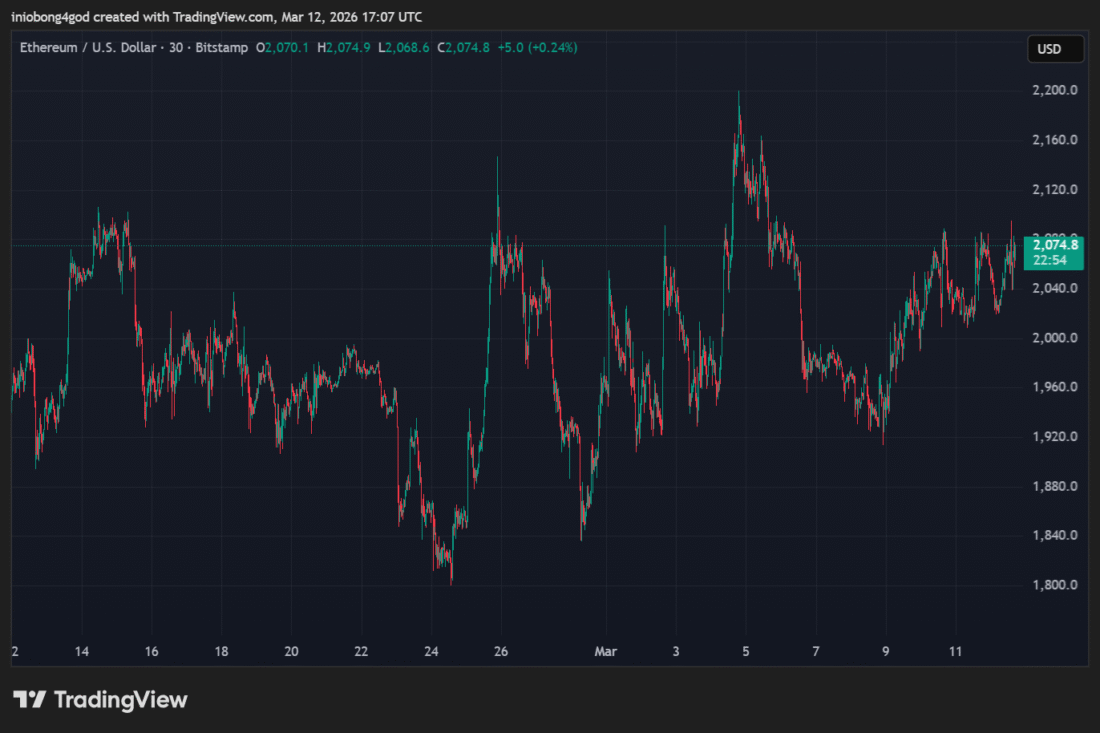

Image Source: TradingView
Current levels sit nearly 60% below Ethereum’s all-time high of about $4,950. Technical conditions on the daily chart continue to show weakness following last year’s breakdown.
Since November, ETH has remained below both the 50-day and 200-day moving averages. During that period, a death cross formed, reinforcing the broader downward trend.
Price action has since moved inside a horizontal channel that began forming on February 6. Support appears near $1,843, while resistance stands close to $2,193.