Bitcoin has climbed above $77,400 on Sept. 18 after the Bank of Japan raised its benchmark interest rate by 25 basis points to 1.25%, its highest level in roughly 31 years, while the yen weakened following the decision.
Summary
- Bitcoin traded above $77,400 after the Bank of Japan raised rates to 1.25% on Friday.
- BOJ approved the 25-basis-point increase by seven votes to two, its second hike since June.
- CoinGecko showed Bitcoin near $77,409, up 1.4%, with $77,624 marking the daily high during trading.
- U.S. spot Bitcoin ETFs drew $159.5 million on September 17, led by BlackRock’s IBIT fund.
- RSI remained neutral-bullish while bearish MACD crossover showed short-term momentum had weakened after Bitcoin’s rebound.
The Bank of Japan said the Policy Board approved the increase from 1.0% by a 7–2 vote as officials responded to inflation risks and continued progress toward the central bank’s 2% price stability target. Reuters reported that policymakers retained guidance indicating rates could rise further if economic activity and prices develop in line with the BOJ’s projections.
Bitcoin price holds above $77K after BOJ decision
At the time of checking, CoinGecko showed Bitcoin at $77,409.41, up 1.4% over 24 hours. The cryptocurrency had traded between $75,971.64 and $77,623.53 during the period, placing the current price close to the upper end of its daily range.
The move followed an overnight decline toward $76,200. BTC recovered to roughly $77,400 after the BOJ decision, while BTC/JPY on Tokyo-based bitFlyer rose around 0.5% to 12.06 million yen.
Foreign-exchange trading moved in the opposite direction. USD/JPY rose from around 156.20 before the rate announcement to approximately 156.70 afterward, showing that the yen weakened despite the higher Japanese policy rate.
Reuters said investors focused partly on the two dissenting BOJ members and the lack of stronger language pointing toward rapid additional tightening. The yen therefore failed to strengthen after a rate decision that had already been widely expected.
Bitcoin’s rise should not be attributed solely to the BOJ meeting. BTC had already started recovering from the $76,000 area before the announcement, while U.S. ETF flows, Federal Reserve policy, Treasury yields, oil prices and geopolitical conditions were moving at the same time.
As recent Bitcoin central-bank coverage previously reported, analysts had identified the BOJ meeting as a potential source of volatility because tighter Japanese monetary policy can increase the cost of yen-funded positions.
BOJ raises rates as inflation risks stay elevated
Friday’s increase took the BOJ policy rate from 1.0% to 1.25%, extending a tightening cycle that has moved Japan further from the ultra-low borrowing costs maintained for much of the previous three decades.
The increase was the BOJ’s second rate hike in roughly three months after policymakers raised the benchmark to 1% in June.
Two Policy Board members opposed Friday’s increase. Reuters reported that the dissenters argued economic conditions did not yet justify another increase, while the majority pointed to inflation risks connected with import prices, energy costs and domestic price-setting behavior.
Japan’s central bank said the economy had continued recovering moderately, although some sectors remained weak. Officials maintained that underlying consumer inflation was gradually moving toward 2%.
Higher oil costs remain one source of pressure because Japan imports much of its energy. A weaker yen can raise those costs further by making dollar-priced commodities more expensive in local currency terms.
The BOJ said it would continue raising its policy rate and adjust monetary accommodation if its economic and inflation outlook is realized. The statement does not commit the bank to a date or size for the next increase.
As earlier BOJ crypto coverage reported after the June increase, higher Japanese rates have drawn attention from digital-asset traders because yen borrowing has historically financed leveraged positions across global markets.
Yen carry trade remains a crypto risk factor
For years, very low Japanese borrowing costs encouraged investors to borrow yen and deploy capital into currencies or assets offering higher returns.
Higher BOJ rates increase the funding cost of those strategies. A rapid rise in the yen can create an additional problem because traders who borrowed the currency must repay liabilities at a stronger exchange rate.
The latest decision did not produce that pattern immediately. The yen weakened and Bitcoin rose after the announcement, meaning Friday’s first reaction did not resemble a disorderly carry-trade unwind.
The interest-rate gap with the U.S. remains sizable. The Federal Reserve raised its target range to 3.75%–4.00% earlier this week, compared with Japan’s new 1.25% policy rate. The difference remains approximately 2.5 to 2.75 percentage points. The Fed’s own rate data confirms the latest U.S. range.
The August 2024 market selloff remains a common reference point because equities and crypto dropped sharply as yen-funded trades came under pressure. Past market behavior does not establish that the same response will occur after subsequent BOJ decisions.
Meanwhile, U.S. monetary policy remains another factor for Bitcoin. Reuters reported that Goldman Sachs and BofA Global Research expect the Federal Reserve to raise rates again in October. Most major brokerages expect another increase later in 2026, commonly in December.
Morgan Stanley does not currently share the October call cited in some reports. Reuters said Morgan Stanley and Macquarie expect a December increase followed by another rate hike in March 2027.
Bitcoin ETFs return to $159.5M net inflows
Institutional flows provided another data point for Bitcoin before the BOJ announcement.
U.S. spot Bitcoin ETFs recorded $159.5 million in net inflows on Sept. 17, reversing two consecutive trading sessions of withdrawals, according to SoSoValue data.

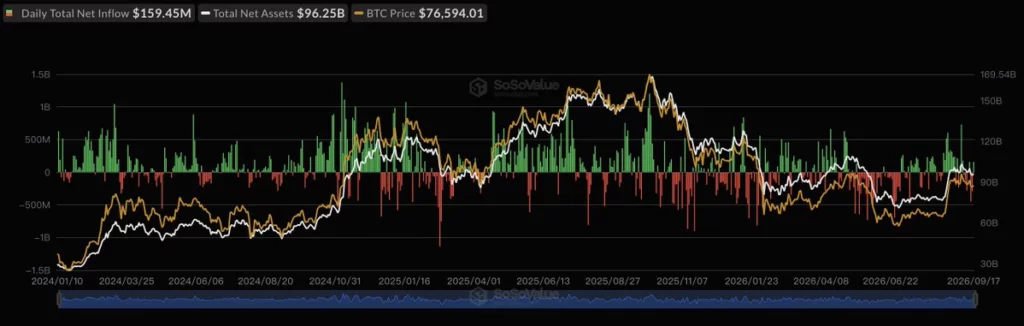
BlackRock’s iShares Bitcoin Trust recorded $183.7 million of net inflows. Fidelity’s FBTC posted $16.6 million in outflows, while VanEck’s HODL lost $7.6 million. The remaining products recorded no meaningful net movement in the reported figures.
The result means IBIT was the only fund with positive net flows in the Sept. 17 dataset, but saying it received $159 million would be incorrect. BlackRock attracted more than the group’s net total because withdrawals from Fidelity and VanEck reduced the combined result.
The inflow followed withdrawals of roughly $450.4 million on Sept. 15 and $295.9 million on Sept. 16, according to the same Farside-based data.
BlackRock’s product remains the largest U.S. spot Bitcoin ETF by holdings. Bitbo data placed U.S. spot ETF holdings collectively at approximately 1.259 million BTC as of Sept. 17, with IBIT holding roughly 784,526 BTC.
In earlier U.S. Bitcoin ETF coverage, the funds recorded a much larger $730.9 million daily inflow on Sept. 3, showing that daily institutional flows have remained volatile through September.
RSI and MACD show momentum cooling below $77,600
The supplied Bitcoin chart shows price recovering from approximately $76,200–$76,400 into the $77,400–$77,600 area before moving into a narrower consolidation.
The 14-period RSI stands at 56.89, below its moving average of 60.55. A reading above 50 keeps the indicator on the positive side of neutral, while remaining below the 70 level commonly associated with overbought conditions.
With the RSI below its moving average, the chart indicates that momentum has eased compared with the earlier stage of the rebound.

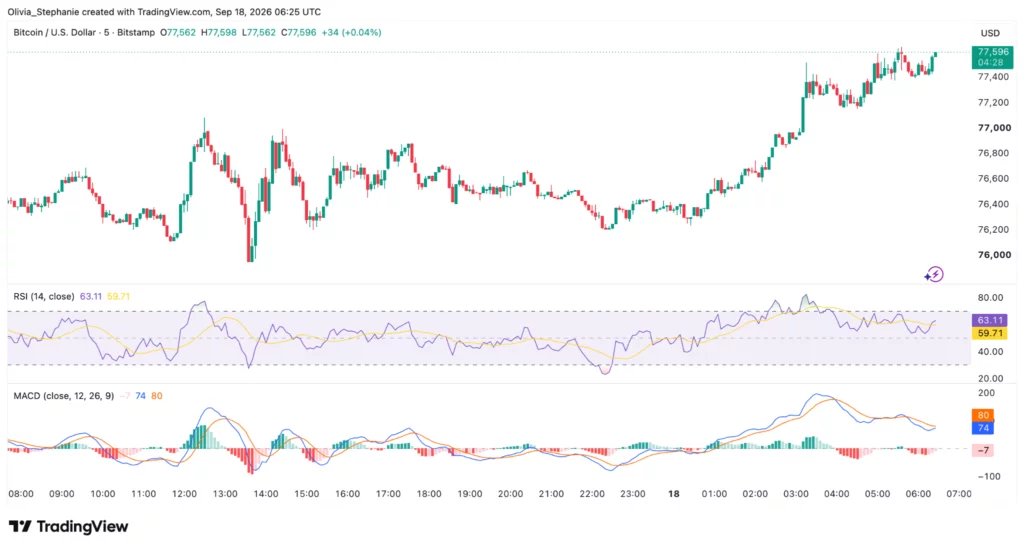
The MACD gives a more cautious reading. Its line is close to 73, below the signal line near 91, while the histogram is approximately -19. The bearish crossover shows that short-term momentum has weakened even as Bitcoin holds above $77,000.
Current CoinGecko data places the 24-hour high at $77,623.53, closely matching the $77,600 area where the supplied chart shows recent candles encountering resistance.
Below the market, the latest CoinGecko range places the daily low near $75,972. Earlier Bitcoin technical coverage identified the $75,000–$76,000 region as an area where buyers had recently returned.
The BOJ’s next policy moves remain conditional on inflation and economic data. For Bitcoin, the immediate market now combines the Japanese rate increase, a still-large U.S.-Japan policy-rate gap, recovering ETF inflows and technical resistance around the upper $77,000 to $78,000 region.
Disclosure: This article does not represent investment advice. The content and materials featured on this page are for educational purposes only.