AAVE shows rising sell pressure as exchange supply grows while derivatives signal weakening demand conditions.
Aave is entering a period of structural stress as internal and market-driven pressures converge. Price action reflects this shift, with AAVE losing the key $100 psychological level during March. Confidence has weakened alongside notable ecosystem developments, raising concerns about near-term stability. Market behavior now points to a transition phase rather than a continuation of prior accumulation trends.
Rising Binance Balances Point to Growing Sell-Side Risk for AAVE
Market analyst Darkfost explained that internal dynamics have played a central role in shaping sentiment. The departure of major contributors, including BGD Labs and Chaos Labs, has introduced uncertainty around development continuity and governance direction. These exits have coincided with a broader deterioration in market confidence, reinforcing a more cautious investor stance.
📈 Aave exchange reserves jump to 2.23M AAVE as sentiment weakens
Aave has recently faced several structural challenges, pushing the protocol into a negative spiral that led it to lose the important psychological threshold of $100 during March.
—> Several internal disagreements… pic.twitter.com/0uNg78uWDl
— Darkfost (@Darkfost_Coc) April 7, 2026
Positioning across the market has started to reflect this change. Participants appear to be rotating toward defensive behavior, either locking in profits or exiting positions altogether. That shift is clearly visible in AAVE’s exchange balance trajectory, which now signals a meaningful structural break.
Exchange reserves have climbed steadily since early February, rising from 2.07 million to 2.23 million AAVE. Binance accounts for a significant share of this increase, with balances growing from 1.57 million to 1.63 million AAVE. More importantly, total exchange balances have now moved above their 90-day moving average, ending a persistent downtrend that began in April 2025.
Such a reversal carries important implications for market structure:
- Rising exchange balances indicate an increase in immediately tradable supply.
- A break above the 90-day average confirms a shift away from long-term accumulation behavior.
- Concentration on major venues like Binance amplifies near-term liquidity and potential sell pressure.
- Trend reversal suggests holders are repositioning rather than withdrawing assets to cold storage.
Market Signals Turn Defensive for AAVE Amid Weak Absorption of Supply
Derivatives data adds another layer of confirmation, though not in an outright bearish extreme. Funding rates have remained largely neutral in recent weeks, fluctuating around zero with occasional negative spikes. This pattern suggests the absence of strong directional conviction rather than a persistent short-dominated market.
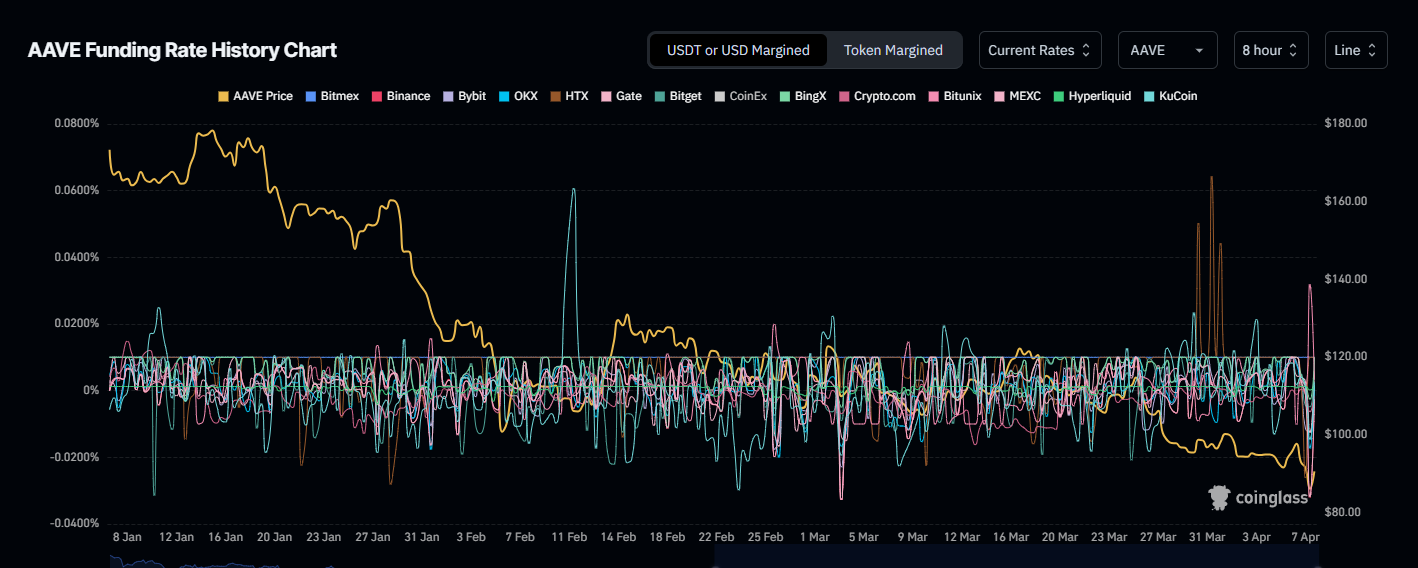

Image Source: CoinGlass
Derivatives data adds another layer of confirmation, though not in an outright bearish extreme. Funding rates have remained largely neutral in recent weeks, fluctuating around zero with occasional negative spikes. This pattern suggests the absence of strong directional conviction rather than a persistent short-dominated market.
At the same time, conditions align closely with spot-driven distribution. Tokens moving onto exchanges are likely being sold into relatively thin demand, rather than supporting new leveraged positioning. This imbalance between supply and demand increases the probability of continued downward pressure.
Broader market conditions reinforce this interpretation. Exchange reserve trends across major assets, including Bitcoin, suggest that the long-standing pattern of supply contraction may be stabilizing. Previous cycles were defined by steady outflows into cold storage, tightening available supply. That trend now appears to be losing momentum.
Against that backdrop, AAVE’s reserve expansion stands out as more aggressive. Asset-specific weakness is combining with a shifting macro structure, creating a less supportive environment overall. Supply is increasing while demand signals remain fragile.